
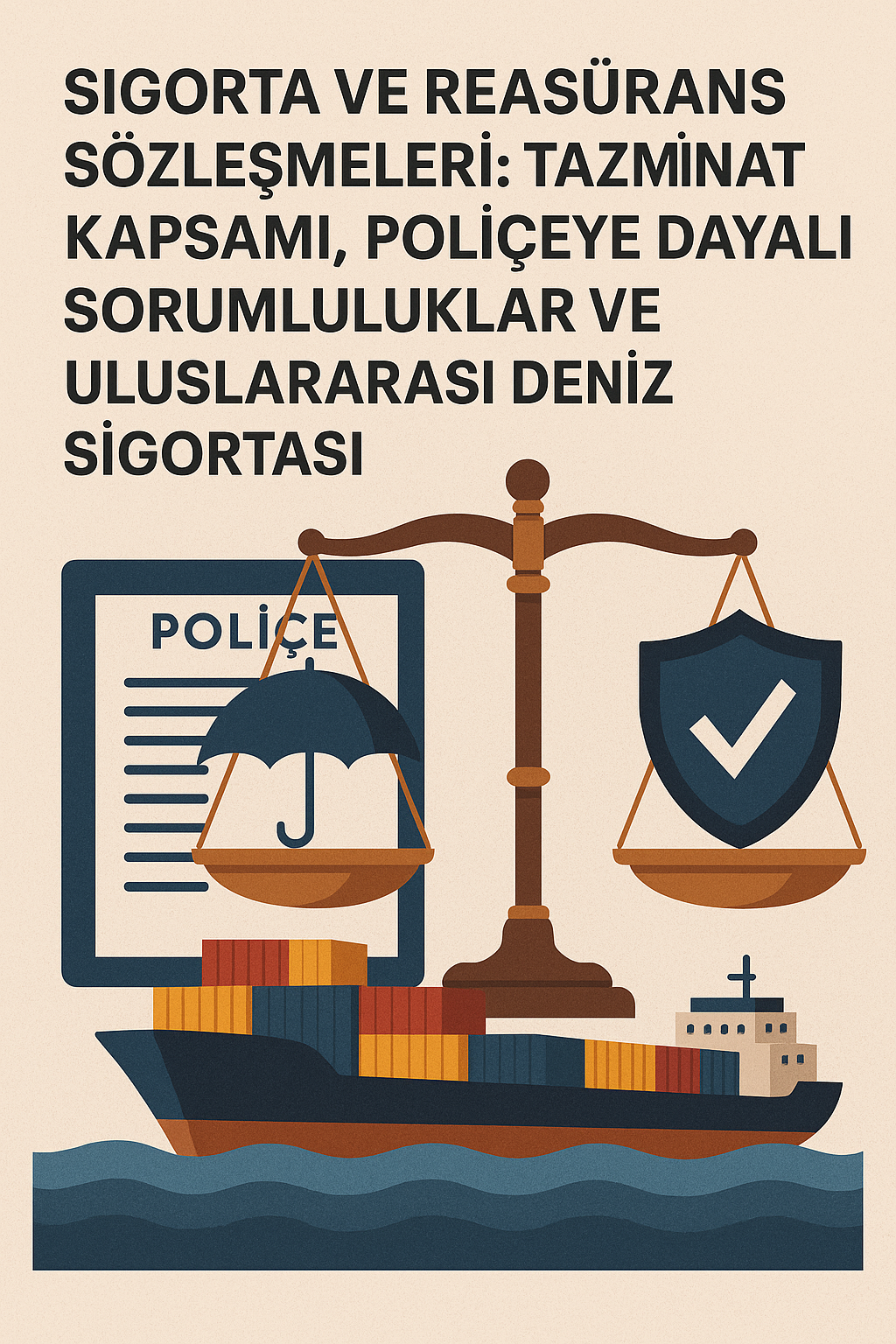
Insurance and Reinsurance Contracts: Coverage, Policy-Based Liabilities, and International Marine Insurance
1. Introduction
Maritime transport is a sector requiring significant financial security due to high costs, natural disaster risks, and multilateral contracts. Large losses that may occur in the event of damage to the vessel, cargo, port equipment, and other elements in the transport process are secured through insurance and reinsurance systems. Marine insurance covers potential risks during the transport process, while reinsurance is a secondary protection mechanism that shares the burden of this risk with the insurer.
This article will discuss in detail the legal nature of marine insurance and reinsurance contracts, the scope of compensation, policy-based liabilities, and the practical application of international marine insurance.
2. Legal Nature and Contract Structure of Marine Insurance
Marine insurance is a specialized type of insurance that provides coverage for assets transported by sea, such as ships and cargo, against risks they may encounter during a sea voyage. Articles 1401 and subsequent articles of the Turkish Commercial Code contain specific regulations in this area.
Insurance contracts are made between the insured, who is obligated to pay premiums, and the insurer, who assumes specific risks. These contracts generally include:
- Surveillance reports,
- Insurance policy,
- Shipping documents (especially bill of lading),
- Stated risks,
- This includes factors such as the warranty period and geographical area
Insurance contracts come into effect "in the event of a risk occurring." In other words, no liability for compensation arises under the policy unless damage occurs. In marine insurance, this damage typically results from cargo loss, damage, delay, or technical problems related to the vessel.
3. Scope of Compensation
Insurance compensation is limited to the coverage specified in the policy. However, some general principles also determine the amount of compensation:
a. The Principle of Compensation for Actual Damages
Insurance is not a means of enrichment. The fundamental principle is to compensate the insured for their losses and restore them to their pre-risk state. Therefore, compensation is determined according to the type and amount of the damage.
b. Scope of Risk
It covers the risks explicitly stated in the insurance policy. For example:
- Maritime accidents (grounding, sinking, collision)
- Fire, explosion
- Theft or loss of cargo
- Damage due to weather conditions
- Risks of war and strikes (included by special clauses)
c. Exception Provisions
Policies may contain certain exclusions. These are situations where the insurance company is excluded from liability. For example,gross negligence of the crew, illegal transportation, undeclared high-risk cargo, etc.
d. Common Average and Averages
According to the concept of general average , one of the most unique areas of insurance law , the losses arising from the ship captain's decisions to discard or damage part of the cargo in order to save it must be shared. These losses can also be subject to insurance compensation.
4. Policy-Based Liabilities
Insurance contracts impose various obligations not only on the insurer but also on the insured. Failure to fulfill these obligations may result in the loss of the right to compensation.
a. Risk Statement
The insured must accurately declare all aspects of the risk (cargo type, route, vessel condition, etc.) at the start of the shipment. Otherwise, the insurance may be deemed invalid.
b. Obligation to Report Damages
When a risk occurs, the insured must notify the insurer of the damage within a certain period (usually 5-7 days) and share the inspection reports.
c. Obligation to Mitigate Damages
The insured is obligated to take necessary precautions to prevent further damage. Failure to do so may result in the partial or complete rejection of compensation.
d. Payment of Policy Premium
The policy may become invalid if the premium is not paid. In marine insurance, due to the long transit times, upfront payment of the premium is generally preferred.
5. Reinsurance Contracts: Insurance of Insurance
Reinsurance is when insurance companies transfer their risks to another insurance company (reinsurer). Especially in maritime trade involving large tonnage shipments, it may not be possible for a single insurance company to assume the entire risk. This is where reinsurance comes in.
Reinsurance contracts:
- It protects the insurer
- It distributes the burden of compensation,
- It ensures financial stability.
In Türkiye, reinsurance transactions are handled by Türk Reasürans A.Ş.; internationally, major reinsurers such as Munich Re and Swiss Re provide this service. Reinsurance transactions are generally carried out using "facultative" or "compulsory" (treaty) systems.
6. International Marine Insurance Standards
In marine insurance, international standards such as the Institute Cargo Clauses (ICC) and Institute Hull Clauses , established by the London Insurance Market , are widely used. These clauses regulate the following:
- Different coverage options with clauses A, B, and C
- Risks of war, strikes, and terrorism
- Start and end points of the transportation period
- Retroactive warranty periods
British marine insurance law is the primary legal system referenced in international maritime transport. Turkish insurance companies frequently issue policies based on these standard clauses.
7. Jurisdiction and Arbitration
insurancecontracts, the competent court and method of resolution are of great importance. According to the Turkish Commercial Code and the Insurance Law, arbitration based in Istanbul or the Turkish Banking Association Insurance Arbitration Commission may be involved in resolving disputes.
For international transport, the ICC Arbitration Rules, LMAA, or other maritime arbitration centers (such as the Singapore Chamber of Maritime Arbitration – SCMA) may be preferred.
8. Case Study and Application
A ship carrying containers from Mersin Port to Hamburg experienced a storm, resulting in some containers falling into the sea and others being damaged. The insured party claimed full compensation under their ICC Clause A cargo insurance policy, but the insurance company refused to pay, considering the ship captain's early departure from port despite the bad weather conditions as "gross negligence".
The dispute was taken to ISTAC arbitration; the expert report revealed that the captain had the option of changing course, and the arbitration panel awarded partial compensation, holding the insurance company 70% liable. This clearly demonstrates how the liability clauses in the policy are interpreted on a case-by-case basis.
9. Conclusion
In a high-risk sector like maritime transport, insurance and reinsurance contracts are vital for establishing trust between the parties and managing financial risks. The scope of compensation, policy-based liabilities, and standards based on international clauses determine how this system operates.
In this context, it is crucial for both shipowners and insurers to seek legal advice when drafting policies, to declare risks transparently, and to establish coverage structures that comply with international regulations. Similarly, arbitration options should be clearly stated in policies to ensure efficient and swift resolution of disputes.
Trainee Instructor Esmanur AKTAŞ


About Post Author
