
What is a flood-prone structure?
Flood-Prone Structure: Criteria for Registration by Assignment, Easement, and Demolition
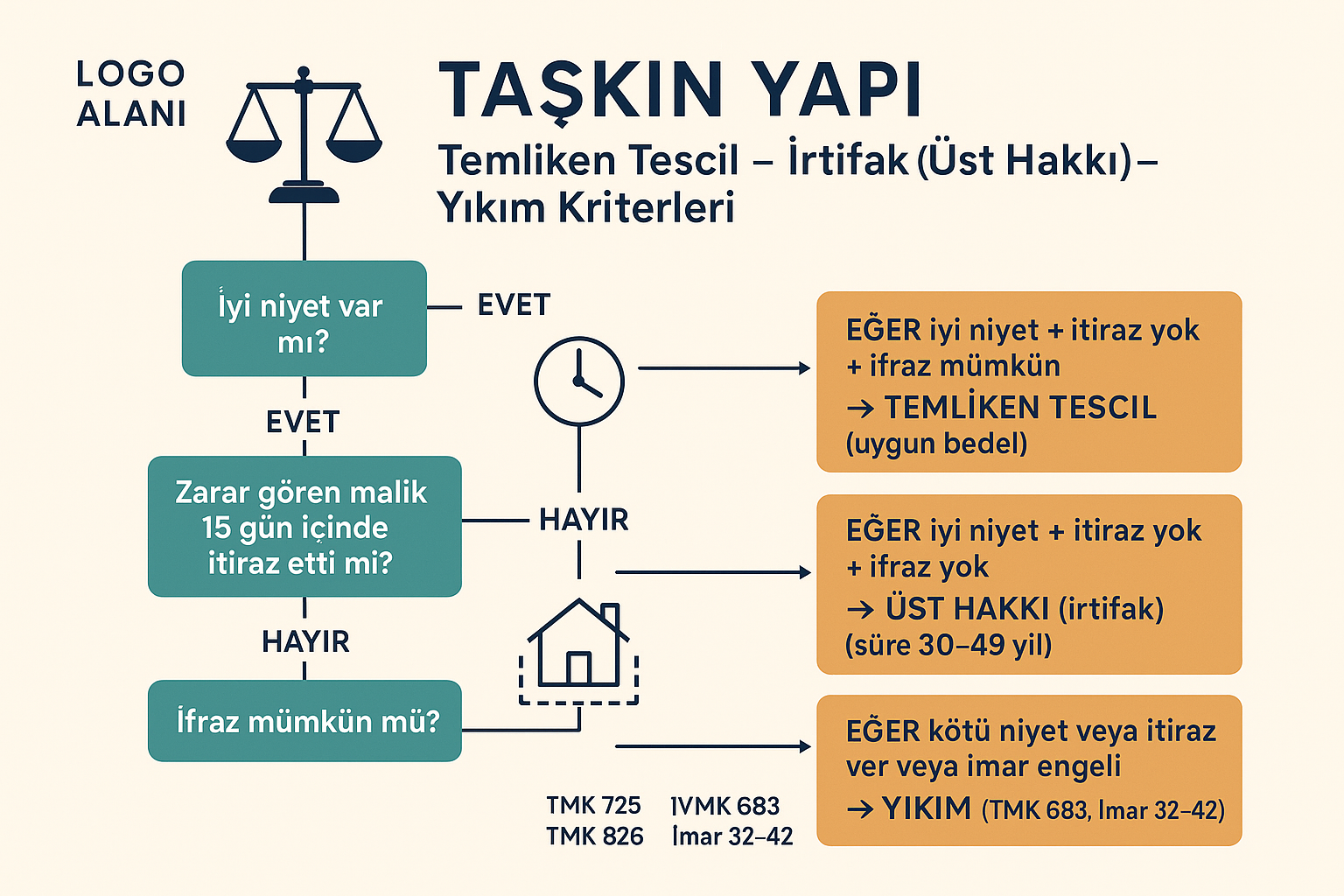
Summary: Encroachment refers to a structure that extends beyond a boundary onto an adjacent property. Good faith , a 15-day objection period , the possibility of subdivision , and appropriate compensation criteria determine whether " registration by assignment " (transfer of ownership of the encroaching portion) or the establishment of an easement (mostly a right of superficies ) will be applied. If there is no good faith, or if the owner has objected within the prescribed time, the rule is demolition/removal . In terms of zoning, Articles 32 (sealing-demolition) and 42 (administrative fine) of the Zoning Law also come into play
1) Conceptual Framework: Reading the Flood Structure in “Three Dimensions”
Property Law aspect: As a rule, "the superior is subordinate to the inferior"; land ownership both the superior and inferior layers to the extent of their usefulness in use . Within this scope, structures are an integral part of the land. Encroaching structures are an exceptional case that pushes the boundaries of this rule.
Flood-prone building regulations (Turkish Civil Code Article 725):
- the builder has an easement over the encroaching portion of the structure, the encroaching section an integral part of the builder's property .
- If there is no easement , and the affected owner does not object within 15 days of learning of the encroachment , and if the circumstances justify it , the owner acting in good faith may request either the transfer of ownership (registration by assignment) or the establishment of an easement at a reasonable price .
Neighborhood-Zoning aspect: Encroachments often arise from errors in zoning and parcel boundaries . Therefore , zoning plans, subdivision and consolidation, setback distances, permit and occupancy permit processes are decisive both in assessing good faith and in the resolution phase. On the administrative side, Article 32 (sealing-demolition) and Article 42 (fine) of the Zoning Law are also applied
2) Conditions for "Registration by Transfer" in the Case of a Flooded Structure
Registration by assignment is a constitutive right that enables the transfer of the land parcel containing the encroaching portion to the building owner in exchange for a suitable price . The main criteria, clarified by doctrine and case law, are as follows:
- Good faith (subjective–objective):
- The property owner should not be aware of the boundary encroachment, nor should they be in a position to detect it through simple care and attention .
- Data such as "scale, application, project, permit, technical supervisor warnings" work against good faith
- The long-standing and established line of jurisprudence rejects the request for registration by assignment from the "owner of the material who has not shown the expected care and diligence".
- No objection should have been filed within 15 days:
- If the affected property owner does not object within 15 days of learning of the encroachment , they may be liable to tolerate the encroaching structure .
- If an objection is filed within the prescribed time limit , demolition/removal is usually ordered.
- Justification by the circumstances and conditions:
- The value of the structure clearly exceeds the value of the land it encroaches upon .
- There should be no excessive disproportion between the interests of the parties,
- Criteria such as the possibility of subdivision (separation of the encroaching part from the main parcel) are sought
- Appropriate cost – fiscal equalization:
- The transfer of ownership is for a "reasonable price" ; this price is determined by an expert , taking into account the land share , increase in value , public restrictions , and subdivision costs . (In practice, the decision to cancel and re-register the title deed is tied to a deposit condition for the price.)
- Procedure–duty–authority:
- Competent court: Civil Court of First Instance (claim for real rights).
- Jurisdiction: The location of the immovable property (Code of Civil Procedure, Article 12).
- Value of the claim: In terms of real property claims/registration, value of the real estate plus the value of the building .
Practical tip: Even when the roles of plaintiff and defendant are reversed, "registration by assignment as a defense" can still be invoked; that is, if the conditions are met in a "prevention of encroachment-demolition" lawsuit filed against you, your registration claim as a defense .
3) "Easement Right" (Surface Right) Option: When and How?
If subdivision is impossible (e.g., due to zoning plan- minimum area , setback distance , or public area restrictions), the court may prefer to resolve the encroaching portion through easement rather than transfer of ownership . The most frequently used type is the right of superficies .
- Definition: A property owner may establish an easement in favor of a third party, granting them the right to construct a building on or under their land or to maintain an existing building ( Turkish Civil Code Article 826 ).
- Independent and permanent nature: If it is established for at least 30 years and is transferable – passable to heirs – it can be registered on a separate page as an “independent and permanent right” ; it will be treated as a separate immovable property in the land registry .
When does the right of superficies arise?
- The encroaching section cannot be separated into individual parcels (no subdivision), but if the preservation of the structure , the balance of interests of the parties, and zoning laws permit, establishing a right of superficies at an appropriate price is equitable .
Content restrictions:
- Duration (mostly 30–49 years in practice),
- Width–depth–height band (projection of the flood portion),
- Maintenance, risk-liability, insurance, rent-like payment/free of charge, transferability-collateralization, and termination terms must be clearly stated in the contract.
4) “Demolition/Removal” Criteria: In Which Cases Is It Unavoidable?
Demolition is the preferred solution in the following situations :
- If the objection was made within the time limit (within 15 days) ,
- the building owner is not acting in good faith (e.g., project/permit/scale data clearly shows boundary encroachment, and construction continued despite municipal/neighbor warnings),
- If it is not possible to protect against flooding due to zoning plans and public order regulations (e.g., encroachment onto roads, parks, or green areas, violations of building density/setback regulations),
- If compensation does not produce a fair result when the interests of the parties and proportionality are taken into account
The basis of the destruction:
- According to Article 683 of the Turkish Civil Code , the owner may request the prevention and removal of unlawful interference (prohibition of interference + demolition)
- In administrative terms, the procedures outlined in Articles 32 (sealing and demolition order) and 42 (administrative fine) of the Zoning Law apply to unlicensed/illegal constructions ; further legal action (annulment lawsuit) is also possible
5) How is Good Faith Evaluated? Application Criteria
- Diligence in boundary demarcation: Failure to examine map-cadastre data, application sketches, UN-reference points , and map sheet conformity is detrimental to good faith.
- Permit-project-technical responsibility: In cases where the project boundary overlaps with the neighboring boundary , encroachment despite warnings constitutes a breach of good faith
- Neighborhood communication: Unilateral "reliance on consent" without seeking written approval is not considered good faith; official records/electronic communication systems are valuable.
- Construction stage: If a neighbor objects at an early stage and the construction proceeds despite this, it constitutes strong evidence in favor of bad faith.
- Proportionality: Millimetric errors are not on the same level as massive excesses ; courts can order demolition even in cases of disproportionately small structures, citing public interest and urban planning regulations
- Case law: If good faith is lacking , the justification of "preserving socio-economic value" alone does not lead to registration by assignment ; demolition or removal prevails.
6) “Justification by Circumstances”: The Four-Legged Test
Let's put into practice the balance test that courts frequently use:
- Economic value test: Value of the structure > encroaching land (clear difference).
- Urban planning test: Is subdivision possible? Is it legitimate in terms of plan, building density, setbacks, roads, and parks ?
- Interest balance test: Is there an excessive burden on the neighboring property owner ?
- Alternative solution test: If subdivision is not possible, can the same balance be achieved by establishing a right of superficies ?
7) Four Scenarios in Practice (Strategy Guide)
Scenario A – “Good faith + no objection + subdivision possible”
- Target solution: Assignment registration.
- Roadmap: Flood area and compensation are determined through survey and expert assessment ; a decision is made to cancel and re-register the title deed with a compensation deposit condition .
Scenario B – “Good faith + no objection + subdivision not possible”
- Target solution: Easement.
- Roadmap: Duration (e.g., 30–49 years), footprint, maintenance and liability, and termination terms are determined; the right of superficies is registered.
Scenario C – “Objection exists (within 15 days) or bad faith”
- Target solution: Prevention of encroachment + demolition; compensation for unauthorized use, if applicable.
- Roadmap: Requests based on Article 683 of the Turkish Civil Code; simultaneous sealing-demolition-fine processes related to zoning (administrative judicial review reserved).
Scenario D – “Clear violation of zoning regulations”
- Target solution: Administrative demolition + fine; demolition a strong possibility under private law.
- Roadmap: Municipality/State of Emergency/Governorate 32-42 ; simultaneously, a private law lawsuit in the neighborhood dispute.
8) Types of Cases, Claims, and Procedural Strategy
Prevention of Encroachment (Prohibition of Interference) and Demolition:
- The plaintiff is the landowner; the basis is Article 683 of the Turkish Civil Code.
- Demand: Demolition + restoration to original condition + compensation for unauthorized use (retroactive compensation for the past 5 years is common practice).
Cancellation of Title Deed and Registration by Transfer / Establishment of Easement:
- The plaintiff is the building owner; the basis is Article 725 of the Turkish Civil Code (conditions specified above).
- Registration is also possible through defense (it can be raised even in the position of the defendant).
Interim injunction:
- Requests for halting construction progress , assessing the current situation (drone/laser scanning – 3D measurement), and applying boundary demarcation measures are evaluated on the grounds of irreparable harm .
Expert testimony:
- Surveying/cadastre + construction expert are mandatory;
- The appraisal expert determines the appropriate price , balances interests , and possibilities for subdivision
Fee-value:
- In cases involving similar claims, there is a Supreme Court precedent regarding the application of fees based on the total value of the real estate plus the value of the building
9) Zoning Law: Sealing, Demolition, and Fines
Sealing & Construction Suspension Report (Article 32):
- an unlicensed or illegal construction is identified, the construction status is documented and the building is sealed; if the irregularities are not rectified, demolition order may be issued.
Administrative Fines (Article 42):
- The initial act (violation) and the continued violation (failure to remedy it) may be punished separately.
- These decisions in administrative courts for annulment .
Note: The zoning amnesty/Building Registration Certificate aims at administrative sanctions. It does not automatically resolve the balance between ownership, easement, and demolition in private law disputes . (In practice, the tests under Articles 725-683 of the Turkish Civil Code are still applied.)
10) How is "Fair Price" Calculated?
- Land plot price: Overhanging projection area × comparable unit value.
- Value decrease/increase: Impact of land use/development rights on the neighboring plot (floor area ratio, setback distance, building approach limit, road dedication requirement).
- Construction value: The integral contribution of the building's value to the overflowing portion .
- Costs: Measurement, subdivision/consolidation, registration, project-static revision, shared walls and facilities .
- a usufruct right is established, based on time (rent-like fee, maintenance and repair costs, risk share).
11) Proof and Evidence Strategy (From a Lawyer's Perspective)
- Technical assessments: Site plan, coordinate-reference point, laser scanning; photo/video-drone recordings.
- Administrative files: Permit-project, building inspection, council decisions, minutes.
- Warning-objection chronology: Notification/KEP records proving the 15-day period
- Witness and neighbor statements: The existence/absence of objections during construction
- Objections to expert reports: Incorrect assumptions regarding zoning and subdivision, measurement errors, and of balance between cost and benefit .
12) Common Mistakes and Arguments Used by the Opposing Side
- The "minor encroachment" fallacy: The "one or two centimeters" rhetoric prevails over the zero-tolerance approach to zoning and setback violations
- The trust in "verbal consent": Proceeding without written consent weakens good faith
- The assumption that "amnesty for illegal constructions will solve it": Private law property and neighborhood disputes.
- Don't forget registration in the defense: In an action to prevent encroachment registration by assignment is not asserted as a defense, a strategic advantage may be lost.
13) Main Criteria Formed in the Supreme Court (Selected Headings)
- Conditions set: Good faith + no objection (15 days) + circumstances + reasonable price + possibility of subdivision; if subdivision is not possible, easement.
- No registration by assignment if there is no good faith: The classic line (emphasis on the decision of the Supreme Court of Appeals dated 14.02.1951).
- Registration is possible through legal action.
- Value of the claim – court fees: In claims relating to property, the value of the real estate + the building is taken into consideration.
14) Application Examples (Fictional Case Studies)
Case 1 – Balcony encroaching on residential block: In Block A, the balcony extends 45 cm into the neighboring plot. The neighboring owner objected via KEP (Electronic Notification System) at the beginning of construction . Good faith is questionable; since the objection period has expired, demolition is more likely. Even if construction progresses, the objection will prevent demolition; the conditions for registration by assignment will not be met. (Administrative demolition/fine is also possible.)
Case 2 – The foundation in the industrial facility has exceeded the 30 cm limit:
The permit and project are on the boundary; there is an application error, and the neighbor has not objected. Good faith can be proven; subdivision is possible. on registration by assignment and a suitable price is awaited.
Case 3 – Overhanging eaves in adjacent buildings:
The planning note restricts the depth of the eaves/projection. The overhang into a public common area . There is no possibility of protection; demolition is inevitable.
Case 4 – Villa wall encroached 20 cm onto neighbor's property: Neighbor noticed after 3 months; no objection after 15 days . Property value > land parcel, no subdivision (plot minimum 400 m²). Solution via right of superficies
15) FAQ – Frequently Asked Questions
Even if the encroachment is "very small," can destruction still occur?
It's possible. Especially zoning and setback violations, the "amount" alone is not enough; public order takes precedence.
Does a neighbor's "verbal" permission count as good faith? No. Written consent or the establishment of an easement/superior right is required
How is the price determined in a transfer of ownership registration? An expert calculates it by taking into account the comparable land value , the size of the flooded area , subdivision costs , and the balance of interests .
Can I request registration as a defense? Yes. In a demolition lawsuit filed against you, registration by assignment can be claimed as a defense.
Will the zoning amnesty solve this problem? It might affect administrative sanctions; it doesn't automatically resolve the balance between property, easement, and demolition in a private law dispute .
16) Checklist for Lawyers (When Opening a File)
- Technical Determination: Application, laser measurement, drone images, coordinate-reference.
- Administrative Files: Permits, projects, building inspections, council decisions, sealing-demolition orders, fines.
- Objection Period: 15 days for objections (yes/no); notification/minutes/KEP records.
- Zoning and Subdivision Review: Parcel minimums, setback-floor area ratio, subdivision/consolidation possibilities.
- Criteria: Good faith – balance of interests – fair price – protectability.
- Claims: Assignment of title / right of superficies / prevention of encroachment – demolition / compensation for unlawful use.
- Procedure: Jurisdiction (Civil Court, Article 12 of the Code of Civil Procedure), value of the claim – fees, precautionary measures.
17) Conclusion: The Right Question, The Right Solution
Building damage cases are multi-layered lawsuits that require a simultaneous examination of ownership (Turkish Civil Code Articles 683, 718, 725) , easement (especially Turkish Civil Code Article 826 right of superficies) , and zoning ( Articles 3194/32–42)
- Good faith and timely objections are two red lines.
- If subdivision is possible , registration by transfer of ownership is required; otherwise, easement/superiority rights are established; and if there is an objection or bad faith, demolition is the norm.
- The triad of cost-benefit-development determines the judge's scale of fairness


About Post Author
