
The Obligation and Legal Validity of Electronic Notifications
The Obligation and Legal Validity of Electronic Notifications
1) Legal Basis and System
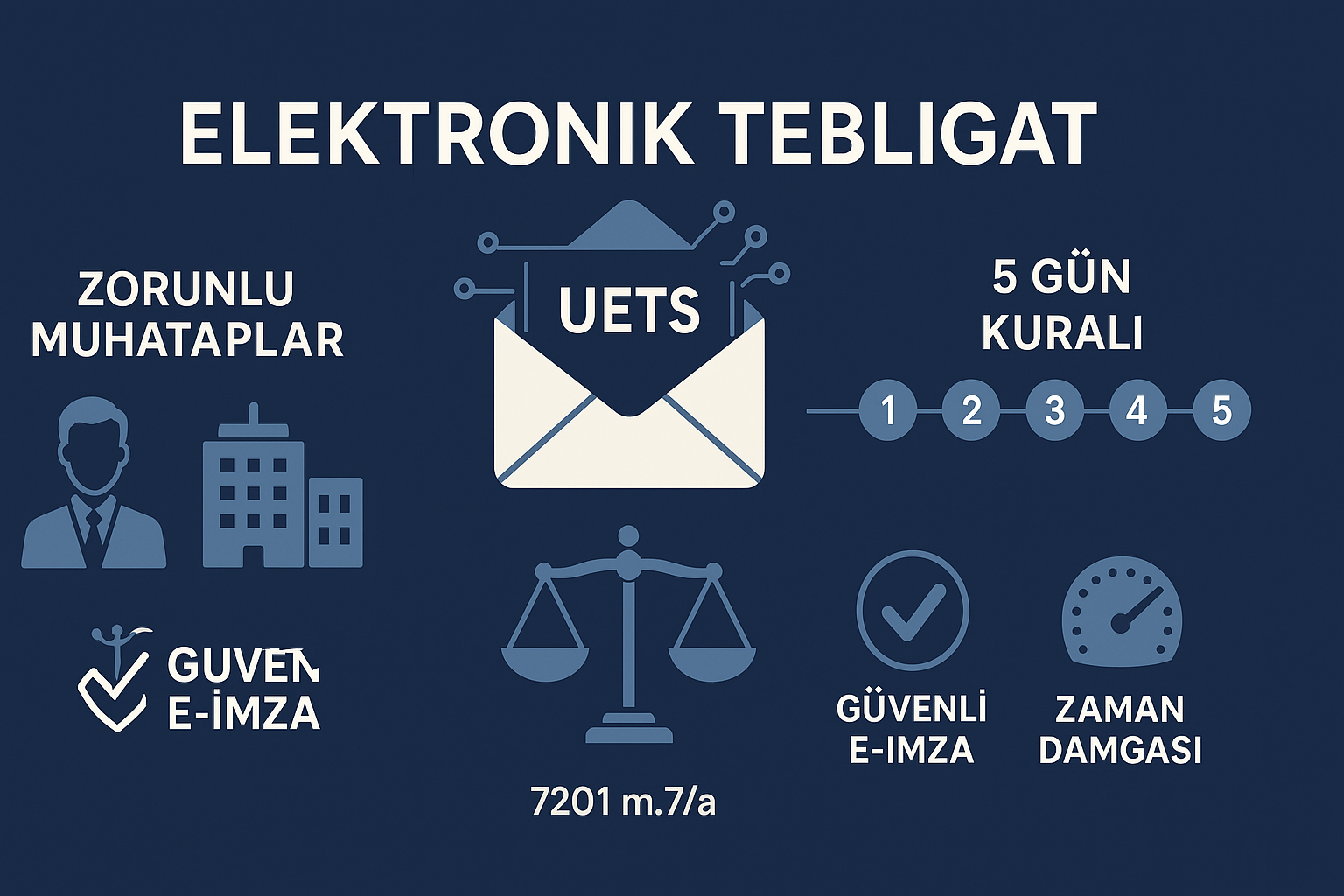
- Article 7/a of the Notification Law No. 7201 contains the fundamental provisions regarding who is obligated to receive electronic notifications , under what circumstances other methods may be used, and the " 5th-day rule ." It also explicitly states that e-notifications will be conducted via the Electronic Notification System (UETS) .
- The Electronic Notification Regulation (06.12.2018 / Official Gazette 30617): Details the procedures and principles; regulates the linking of notification packages with secure electronic signatures and timestamps , evidence records, and operation
- UETS (PTT): This is the national infrastructure established and operated by PTT A.Ş.; it was commissioned on January 1, 2019. UETS proves that the notification has reached the recipient's account documentary evidence; SMS/email informational purposes only (it is not the notification itself).
2) For whom is e-notification mandatory?
According to Article 7/a of Law No. 7201, e-notifications compulsorily sent to the following:
- Public administrations and revolving fund entities listed in the annexes to Law No. 5018 ,
- Local administrations,
- Other public institutions/organizations established by special law, as well as funds and guarantee funds established by law ,
- State-owned enterprises and their affiliated companies/institutions/businesses,
- Other partnerships in which more than 50% of the capital is publicly owned,
- Professional organizations and their umbrella organizations that have the status of public institutions,
- All private legal entities, including those established by law (including capital companies),
- Notaries,
- Lawyers registered with the bar association,
- Mediators and experts,
- The units to which the persons authorized to represent these individuals and institutions as proxies are affiliated. Individuals/legal entities outside the scope may obtain an e-notification address upon request , in which case notifications will be sent to them electronically .
Practical conclusion: Companies registered in the commercial registry (Joint Stock Companies, Limited Liability Companies, etc.), private legal entities, and individuals with the status of lawyers, mediators, and expert witnesses eligible for e-notifications. Physical notification is not the "primary method".
3) How Does E-Notification Work? (UETS Process)
- The competent authority (court, enforcement office, administration, etc.) signs, packages , and transmits the notification documents to the UETS ( Electronic Notification System) using an electronic signature
- UETS delivers the package to the recipient's account with a timestamp and generates a series of evidence records including " delivered " (evidence such as read/unread, expiration date, and "acknowledged read").
- UETS can inform the recipient via SMS/email ; however, the legal validity of the notification arises upon receipt by UETS and the 5th-day rule stipulated in the law .
4) The "5th Day Rule" and the Start of Time Limits
Rule: “ Electronic notification shall be deemed served at the end of the fifth day following the date it reaches the recipient's electronic address. ” (Article 7201, paragraph 7/a). This provision has been adopted verbatim in the Electronic Notification Regulation
The Constitutional Court (E.2018/144, K.2019/72; Official Gazette 26.11.2019) rejected the appeal on the grounds that the 5-day period was reasonable and did not impair the right to seek redress . Although this decision was given regarding a similar rule in Article 107/A, paragraph 2 of the Tax Procedure Law concerning tax notifications, the logic of the norm is the same .
Court of Appeals practice: Although there are periodic differences in approach among the chambers, the current trend is based on the 5th-day rule ; if there is evidence of reading, this may indicate an earlier date, but even if the law has not been read, it presumes notification by the end of the 5th day. In practice, the "earliest date" approach (day of reading) is preferred to prevent loss of rights , but the rule itself is the 5th day .
Example: The notification reached your UETS account on October 1st , and you opened it on October 2nd . Although some courts debate starting the process from the date of receipt , legally, the notification is considered served as of 23:59 on October 5th ; the deadlines begin running no later than this time. To avoid risk, it is safer to process the transaction based on the October 2nd date
5) What happens to physical notification when it is absolutely necessary?
Even when electronic notification is mandatory , notifications made via physical method create a validity problem. In its decision dated June 4, 2024 (E.2024/857, K.2024/5782), the 12th Civil Chamber of the Supreme Court of Appeals emphasized that in a case where electronic notification is mandatory , processing the case with a physical notification , even if the debtor claims a "date of learning" about it , does not have legal effect and constitutes a procedurally incorrect notification. This approach indicates that an incorrect procedure in the face of mandatory electronic notification can create a nullity/invalidity effect
6) Validity Requirements (Technical and Procedural)
- Secure electronic signature and timestamp: The notification package is signed with a secure e-signature and associated with a timestamp by the UETS (Electronic Notification System); throughout the process, evidence such as "received/not received, read/not read, time expired-accepted as read" is generated. These logs are crucial for proving the notification .
- Address management: UETS e-notification addresses are created uniquely based on identity/system numbers ; authorized authorities can search for recipients in the Address Directory
- Other methods in case of necessity: If e-notification cannot be made for a compelling reason (systemic or legally valid obstacles), other notification methods may be employed. This is an exception , not an "arbitrary choice" .
7) Most Frequent Dispute Topic and Judicial Tendencies
- The defense of "I didn't read it, I didn't receive an SMS": SMS/email is merely for informational purposes ; the validity of the notification is determined by the UETS records. Even if unread , the notification is considered delivered at the end of the 5th day .
- The debate over reading day vs. day 5: Although different decisions have been seen in practice, the text of the law takes day 5 as the basis; the Supreme Court of Appeals and chamber decisions have established consistency in this direction. In disputed cases, the reading date should also be taken into account to reduce the risk of a delay against the defendant.
- Physical notification to the mandatory recipient: the mandatory medium electronic , physical notification valid ; "learning" may not initiate the time period (12th Civil Chamber, 2024).
8) Compliance Checklist for Businesses and Practitioners
- your UETS account active? a handover and notification process carried out when authorized personnel change?
- Internal procedure : Is the UETS box checked daily ? Is there a backup responsible person for holiday/leave periods?
- Are your notification channels (SMS/email) up to date? (Remember: these are reminders only, not official notifications .)
- Are the evidence reports regularly archived? Are the UETS logs stored in a way that allows them to be presented to the court when required?
- Power of attorney relationships : Is the address directory checked when the attorney/representative changes ?
- Was the UETS address/account updated after company mergers/changes of legal form ?
- Are separate UETS (Unified Electronic Document Management System) statuses tracked for professional roles such as mediator and expert witness ?
9) FAQ (Frequently Asked Questions)
Q1: Does the time limit start if I don't open the e-notification at all? Yes. Even if the e-notification is not read , it is considered served at the end of the 5th day following the date it reaches the recipient's email address . To avoid the risk of disputes, if the date it was read is earlier , do not miss the forfeiture/application deadlines according to that date.
Q2: I didn't receive the SMS/email; is the notification invalid?
No. The SMS/email for informational purposes. Validity is determined by UETS records.
Q3: Is e-notification mandatory for lawyers?
Yes. Lawyers registered with the bar association are subject to e-notification.
Q4: A traditional notification was sent instead of an e-notification; is it sufficient to state the date I learned about it?
Generally, no. When e-notification mandatory , a physical notification does not provide validity; the "date of learning" is in most cases ineffective (Supreme Court 12th Civil Chamber, 04.06.2024).
Q5: Isn't the 5-day rule unconstitutional?
The Constitutional Court, in its decision dated September 19, 2019 (E.2018/144, K.2019/72), found the 5-day rule to be reasonable .
10) Implementation-Oriented Strategic Notes
- A conservative approach to calculating deadlines: "read" the reading dateas the basis; otherwise, the 5th dayas the basis the earliest date is a safer approach for appeal/cassation and objection deadlines.
- Procedural efficiency and proof: notification disputes UETS logs . Technical criteria regarding evidence structures, signature formats, and timestamp standards are detailed in the UETS Procedures and Principles.
- Objection to improper notification method: If physical notification has been made to the mandatory recipient , the issue may be one of nullity rather than irregularity ; strong arguments exist for the time limits not having started and for the cancellation of the process (12th Civil Chamber, 2024 trend).
- The public-private distinction is disappearing: the broad range of recipients in Article 7/a covers all "private legal entities"; e-notification should be established as the primary channel in the business world
11) Conclusion
E-notification is the primary notification channel in Turkey. Evidence recorded on the UETS system with secure e-signatures and timestamps definitively proves both the delivery of the notification and when it was delivered . The 5th-day rule makes the start of deadlines predictable; the Constitutional Court has found this to be constitutional . However, a return to physical notification for mandatory recipients creates significant validity issues and is generally not accepted in the Supreme Court's practice. The solution for companies and professionals is to make UETS an integral part of their daily workflow , regularly archive evidence reports , and structure deadline management according to conservative principles.


About Post Author
