
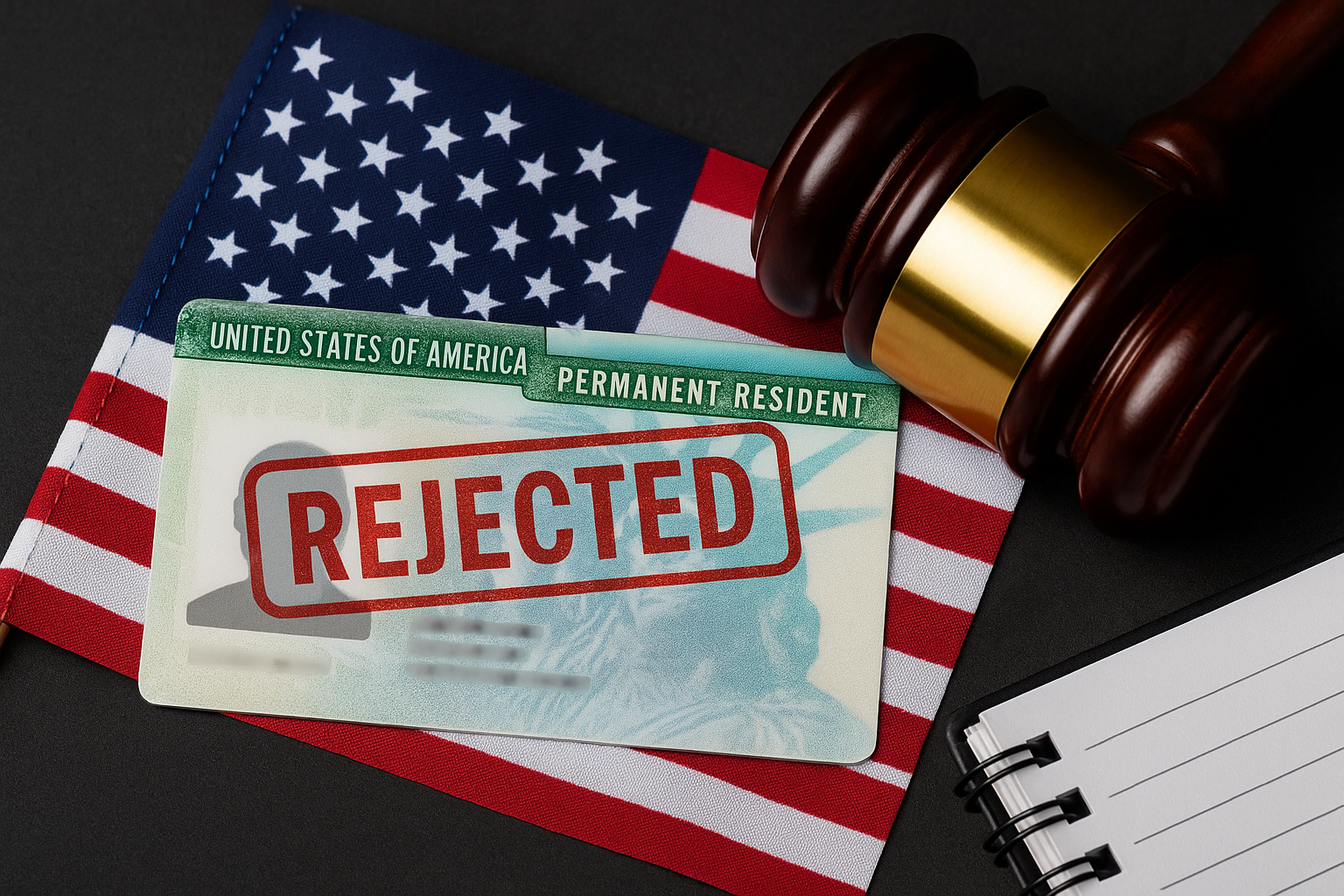
My Green Card application was rejected, what should I do?
A Green Card , which grants permanent residency and the right to work in the United States, is a vital document for many foreign nationals. However, there is no guarantee that Green Card applications will always be successful. USCIS (US Citizenship and Immigration Services) or US Consulates reject tens of thousands of applications each year for various reasons.
This article will detail the legal avenues available if a Green Card application is rejected, appeal mechanisms, re-application strategies , and key procedural guidelines to consider
1. What Does a Green Card Application Been Rejected?
A Green Card refusal occurs when USCIS or a U.S. Consulate determines , as a result of its assessment, that the applicant does not meet the legal requirements for permanent residency
A rejection may be given as a result of the file review or during the interview stage.
2. Reasons for Rejection
2.1. Missing Documents or Incorrect Statements
-
Incomplete or incorrectly completed forms (I-130, I-140, I-485, DS-260)
-
Insufficient supporting documents
-
Misleading or contradictory information
2.2. Criminal Record and Public Safety Risk
-
Criminal history (theft, forgery, domestic violence, human trafficking, etc.)
-
Membership in a terrorist organization poses a threat to public security
-
Visa violations or past illegal US residency
2.3. Public Charge Risk
According to the rules updated in 2022, applications that carry the risk of reliance on US public funds may be rejected.
The relevant form is: Form I-864 (Affidavit of Support).
2.4. Health Reasons
-
Non-compliance with vaccination requirements
-
The presence of dangerous infectious diseases (e.g., active tuberculosis)
2.5. Fake Marriage or Attempts at Illegal Immigration
-
In marriage-based Green Card applications, the belief that the marriage is fraudulent
-
Using forged documents in previous visa applications
3. What to do if your application is rejected
3.1. Review of the Rejection Decision
When a denial is issued, USCIS sends the applicant a formal “Notice of Action” (Form I-797) .
This document states:
-
Reason for rejection
-
Whether there is a right to appeal
-
Objection period
-
Alternative application methods
It is stated.
Critical: If there is no right to appeal, a new application or other legal strategy must be pursued.
4. Legal Appeal Mechanisms (Appeal, Motion)
4.1. Appeal – Form I-290B
against USCIS's denial decision the Administrative Appeals Office (AAO) or the Board of Immigration Appeals (BIA) .
-
Form: I-290B
-
Timeframe: 30 days from the date of rejection (33 days by mail)
-
Salary: $675 (as of 2025)
For the appeal to be successful:
-
New evidence
-
Reasons showing that the decision is unlawful
-
Documents supporting the completeness of the previous application
4.2. Request for Reconsideration of the File (Motion to Reopen / Reconsider)
a) Motion to Reopen
-
Newly discovered documents or information are presented.
-
A review of the events is requested.
b) Motion to Reconsider
-
USCIS a legal error .
-
No new documents will be submitted; only a legal analysis will be conducted.
The timeframes are the same: 30 days after rejection
5. Re-Filing
Instead of going through the appeals process, it might be more effective to correct the errors and submit a new application.
When is it advantageous?
-
If there are missing documents in the initial application
-
If it was rejected due to insufficient sponsorship
-
If there is no violation of status and the right to apply continues
Example:
If a Green Card application is rejected due to insufficient financial resources indicated on Form I-864, a new application can be submitted with a co-sponsor
6. Court Process and Filing a Lawsuit (Federal Court)
If an application results in a direct visa refusal and there is a serious legal violation, in federal court (District Court) .
In which cases?
-
Visa interview rejection
-
Arbitrary or abuse-of-discretionary refusals
-
Situations where USCIS exceeded deadlines
Available Legal Tools:
-
Mandamus action: This is initiated when USCIS fails to take action.
-
Administrative Procedure Act (APA): Applied against unlawful actions of the administration.
7. If you are outside the U.S.: Immigrant Visa Rejection
DS-260 immigrant visa applications from outside the US may also be rejected by the consulate.
Reasons for rejection:
-
Incorrect information on the form
-
Risk of public burden
-
DS-5535 (advanced security scan)
-
Medical deficiencies
The refusal is explained on the grounds of “212(a)” according to the immigrant visa status . This means:
-
212(a)(4): Public burden
-
212(a)(6): Forgery
-
212(a)(9): Illegal entry into the United States
Solution:
-
A re-interview can be scheduled after completing the missing documents
-
The application can be repeated after a certain period of time has passed
-
In some cases, an application for a waiver can be made
8. Status Maintenance and Process Management After Rejection
Individuals applying within the US may face the risk of becoming stateless if their Green Card application is rejected
What should be done?
-
A switch to another valid status (e.g., student visa, tourist visa extension, etc.) should be considered immediately
-
It is possible to remain in the country during the appeal process , but if the status is not extended, there is a risk of deportation.
-
The "unlawful presence" period begins, which can result in an entry ban of 3 to 10 years
9. Legal Support and the Importance of a Lawyer
A Green Card refusal is not merely an administrative process; it is often directly related to a person's entire immigration history.
Advantages of Having a Lawyer:
-
Legal analysis of the grounds for refusal
-
Preparation of the appeal petition
-
Planning alternative application strategies
-
Preparing for USCIS interviews
-
Monitoring court proceedings
10. Frequently Asked Questions
❓ If my Green Card application is rejected, do I have to leave the country immediately?
No. You can stay in the US if your status hasn't expired or you're in the appeals process.
❓ Is there a time limit for re-application?
No. If the reason for rejection no longer exists, you can reapply.
❓ After a rejection, is it more logical to appeal or reapply?
It depends on the situation. Re-filing is preferable if there are missing documents, and an appeal is preferable if there is a legal error.
Conclusion
Being rejected from a Green Card application can be disheartening. However, this decision final . Numerous legal remedies exist, including appeals, reapplies, or filing a lawsuit. Each application has its own unique dynamics; therefore, accurate legal analysis and professional guidance are vital.
Even if your Green Card application is rejected, your dream of going to the US doesn't have to end with the right strategy.


About Post Author
