
ICC Arbitration Rules
Arbitration is one of the most reliable and preferred methods for resolving disputes between parties in international commercial relations . The ICC – International Chamber of Commerce Arbitration Tribunal , in particular, stands out as one of the most prestigious arbitration institutions worldwide. In ICC arbitration, in addition to parties submitting their claims and defenses in written petitions, oral hearings are often held. These hearings allow the arbitration panel to better understand the dispute, enable the parties to present their claims and defenses orally, and allow witnesses to be heard directly.
This article the principles of hearings in ICC arbitration ; the rights and obligations of the parties, the methods of presenting evidence, the role of the arbitration panel, and the decision-making process will be explained from an international trade law perspective.
1. Nature of the Hearing
In ICC arbitration, hearings confidential , and only the parties, their lawyers, the arbitration panel, and invited witnesses/experts can attend. In this respect, arbitration differs from state courts. The fact that it is a closed-door proceeding allows the parties to protect their trade secrets and business relationships.
Hearings are not mandatory. The arbitration panel can make a decision solely based on the case file. However, in practice, holding hearings is preferred, especially in high-value disputes or cases where technical evidence is discussed.
2. Determining the Procedure
Prior to the hearing, the arbitration panel a procedural conference (case management conference) . During this conference:
-
The scope of the hearing,
-
The order in which witnesses and expert witnesses are heard,
-
Cross-examination methods,
-
The hearing will be held either in person or online
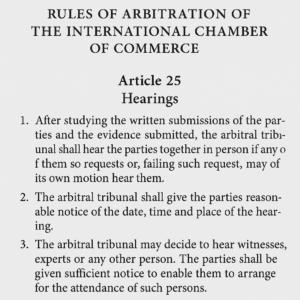
This is decided. Article 25 of the ICC Arbitration Rules grants the arbitral tribunal broad discretion in determining the procedure of the hearing.
3. Location and Language of the Hearing
The seat of arbitrationmay be determined by the parties in the contract. For example, Paris, London, Istanbul, or Singapore. The seat of arbitration also affects the legal framework of the decision; since which country's courts will have jurisdiction during the enforcement phase depends on this choice.
The language of arbitration is usually the language used by the parties in their commercial relations. English is the most frequently preferred language in ICC arbitration. However, the parties may choose languages such as Turkish, French, or German if they wish.
4. Participation and Representation of the Parties
In court proceedings, parties are represented by their lawyers. Lawyers make oral statements on behalf of their clients, question witnesses, and present legal assessments to the arbitration panel.
The hearing usually opening statements . In this section, the parties summarize the essence of the dispute and explain which evidence is important and why.
5. Presentation and Examination of Evidence
The principle of freedom of evidence applies in arbitration . Even if the parties have submitted their written evidence beforehand, at the hearing:
-
Witnesses,
-
Expert consultants,
-
Technical report owners
The parties are heard. The arbitration panel freely evaluates the evidence presented by the parties.
In ICC practice, the IBA Rules on the Taking of Evidence in International Arbitration are frequently considered. These rules strike a balance between continental European and Anglo-Saxon legal systems. For example:
-
Witnesses submit their written statements in advance
-
Cross-examination takes place during the hearing
-
Referees can also ask direct questions when necessary.
6. Oral Statements
The fundamental element of the hearings is the oral statements of the attorneys for the parties. The process consists of the following stages:
-
Opening Statement: A summary of the dispute by the parties.
-
Presentation of Evidence: Hearing of witnesses and experts.
-
Closing Statement: The closing statements made by the parties summarizing the case.
These statements contribute to the arbitration panel's assessment of the dispute in all its aspects.
7. The Role of the Arbitration Panel
The arbitration panel maintains order during the hearing and ensures that both sides are heard equally. Arbitrators are impartial, but unlike state judges, they can take a more active role. They can ask direct questions to witnesses and party representatives.
This situation strengthens the arbitration panel's obligation to uncover the truth, especially in disputes involving technical issues.
8. Minutes and Records
All statements made during the hearing are generally stenography . With the consent of the parties, audio or video recordings may also be made. These recordings assist the arbitration panel in writing the decision.
The parties are usually sent copies of the trial transcripts. This ensures transparency in the proceedings and guarantees the parties' right to defense.
9. Post-Hearing Process
After the hearing concludes, the arbitration panel may grant the parties time to submit additional evidence or statements. Following this stage, the case is closed and the decision phase begins.
According to Article 31 of the ICC Arbitration Rules, the arbitration panel is generally the final award within six months .
10. Example Scenario: Hearing in ICC Arbitration
For example, in a machine delivery dispute between a company operating in Türkiye and its partner in Germany:
-
The plaintiff demands a payment of 1 million Euros
-
The defendant raises the defense of defective goods
-
The parties present their witnesses at the hearing
-
An independent expert report confirms that the machines are free from defects
-
The arbitration panel decides that the payment obligation must be fulfilled.
This example demonstrates how hearings directly influence arbitration decisions.
11. Advantages of Arbitration Hearings
-
Confidentiality: Trade secrets are protected.
-
Expertise: Arbitrators are selected from individuals who are experts in the subject matter of the dispute.
-
Flexibility: Hearing procedures can be adapted to the needs of the parties.
-
International validity: The decisions are recognized in more than 170 countries thanks to the New York Convention.
Conclusion
The hearing procedures in ICC arbitration offer parties a fair, transparent, and flexible dispute resolution process. Confidentiality, equality of parties, freedom of evidence, and the expertise of the arbitration panel are fundamental principles of this process.
In terms of establishing trust in international trade and protecting investors, ICC hearingsare at the heart of arbitration proceedings. Therefore, arbitration clauses in contracts are not merely a legal formality but also a vital safeguard for the sustainability of commercial relationships.


About Post Author
