
How to Conduct a Consular Interview at US Immigration Office?
1. Introduction: What is a Consular Interview and Why is it Necessary?
In the U.S. immigration system, the consular interview is one of the final and most critical stages for applicants residing outside the U.S. to immigrate to the U.S., whether they are applying for a permanent residency (Green Card), family reunification, marriage, investment, or employment-based visa.
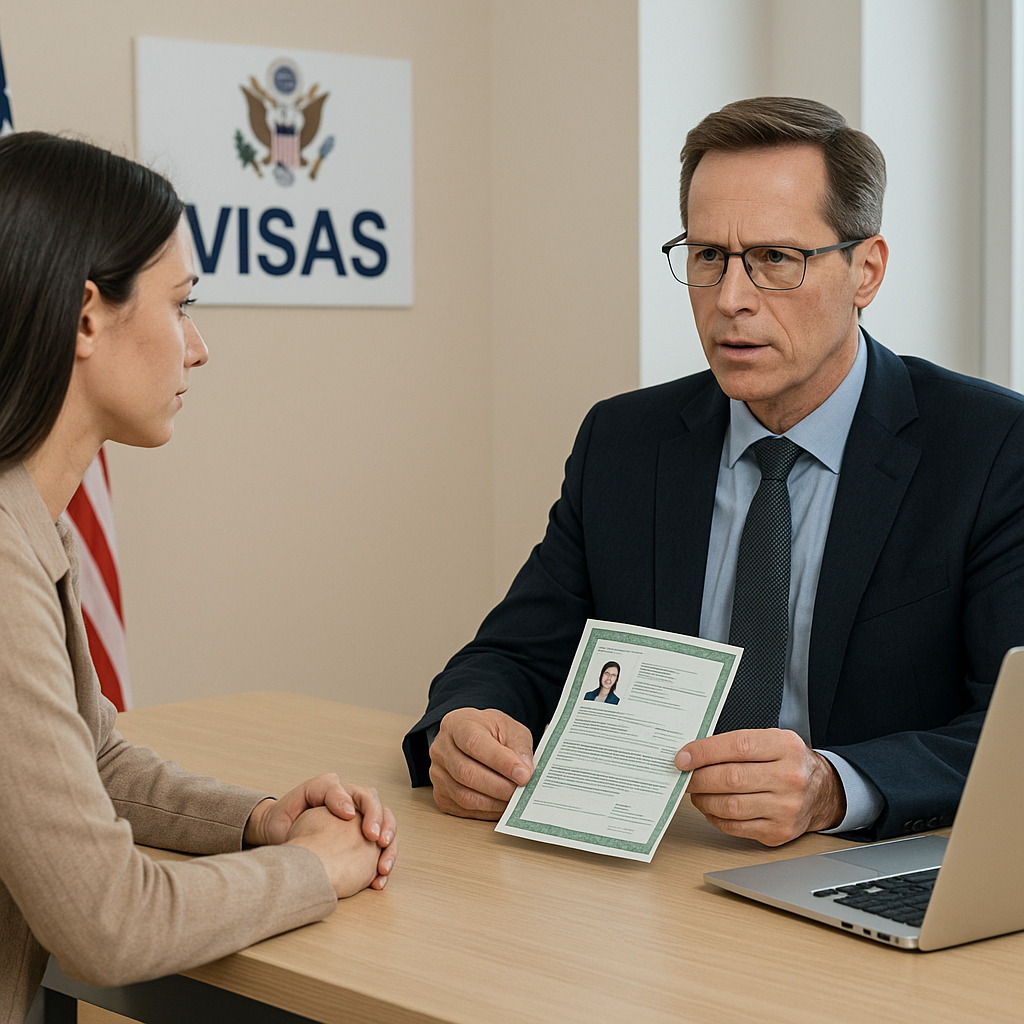
The applicant is interviewed in person at a U.S. consulate or embassy in their home country (or the region where the application is being made). This interview is conducted to determine the applicant's eligibility to enter the U.S., verify documents, prevent fraud, and ensure U.S. public safety.
2. The Legal Basis and Significance of Consular Interviews
-
the Immigration and Nationality Act (INA) and the Code of Federal Regulations (CFR) , every immigrant applicant undergoes an “immigrant visa interview” to assess their eligibility before a visa is granted (INA 221, 22 CFR 42.62).
-
It is a legal requirement for the consular officer to personally evaluate the applicant's statements and documents.
-
The decision is largely at the discretion of the consular officer. Therefore, the preparation process is very critical.
3. Who participates in the consular interview?
-
All applicants who have not undergone a change of status (Adjustment of Status) in the US, i.e., those applying for immigrant visas from abroad (e.g., family reunification, marriage visa, employer sponsorship, investor visa).
-
The primary applicant and, if applicable, the spouse and children under the age of 21 (dependent applicants).
-
Interviews are generally conducted only with the applicants; depending on the type of application, the sponsor (e.g., a US citizen spouse) may also be invited for an interview.
4. Preparing for a Consular Interview: The Step-by-Step Process
4.1. Immigration Application Approval and DS-260 Form
-
The U.S. Citizenship and Immigration Services (USCIS) or the National Visa Center (NVC) will notify the applicant that the application has been deemed eligible.
-
The applicant completes and submits the DS-260 Immigrant Visa Application Form online
-
The form requires declaration of personal information, family history, education and work history, contact person in the US, and previous travel.
4.2. Gathering and Preparing Documents
Complete and up-to-date documents are required for the application.
The most commonly requested documents are:
-
Passport (valid for at least 6 months upon entry to the USA)
-
Birth certificate and/or population registration record
-
Marriage certificate/divorce/death certificates (if needed)
-
Criminal record (police record)
-
Military service status certificate
-
Medical report (certified by the panel physician)
-
Financial support (I-864 Affidavit of Support) and sponsor's income documents
-
Educational and professional documents (diploma, transcript)
-
Photograph (white background, recent, conforming to US visa format)
-
Documents related to previous US visas/travels
4.3. Scheduling and Following Up on Interview Appointments
-
If the documents are complete, the NVC will inform the applicant of the date and time for their consular interview.
-
Continuous monitoring via email and/or online system (CEAC) is recommended.
-
Note the appointment location, date, and time, and be on time on the day of your appointment.
4.4. Medical Examinations and Vaccinations
-
Prior to consular visit, a comprehensive medical examination (blood tests, chest X-ray, infectious disease screening, and vaccination check) by a panel of physicians approved by the U.S. is mandatory.
-
The results are collected in sealed envelopes and brought to the interview.
5. Consular Interview Day: What Happens?
5.1. Security Check and Document Submission
-
You must pass through security upon entering the consulate building. Electronic devices are not allowed.
-
The appointment letter and documents are checked, and a number is assigned.
-
The documents are submitted and often biometric data (fingerprints) are collected.
5.2. Interview Procedure and Question Types
-
The consul or visa officer conducts a brief but focused interview with the applicant (usually 3-15 minutes).
-
Questions vary depending on the type of application:
-
Family reunification: Proof of marriage, meeting story, cohabitation, evidence of communication (photos, messages, bank accounts, etc.)
-
Employer sponsorship: Company, work experience, position, job offer
-
Investment: Investment source, business plan, state of the business in the US
-
-
Criminal record, health, past US visa violations, immigration history, financial status, and life plans in the US are all checked.
5.3. Language and Translation Support
-
Interviews are generally conducted in English; however, most consulates allow interviews in the local language and the use of interpreters.
-
Refusal on the grounds of language deficiency is generally not applied; truthful explanation is essential.
6. Things to Consider and Practical Tips for Consulate Interviews
-
All documents must be original, current, and official; missing documents will invalidate the interview.
-
False statements, falsification of documents or forgery may result in a lifetime visa ban (212(a)(6)(C)(i)).
-
During the interview, it is recommended to give honest, concise, and clear answers, avoiding unnecessary details.
-
The sponsor's financial documentation must be strong; financial sufficiency is particularly scrutinized in family reunification and DV Lottery applications.
-
To prepare for legal questions, you can research sample interview questions online, depending on the type of application.
7. Post-Interview Results and Follow-up
7.1. Visa Approval
-
Once the visa is approved, the passport will be delivered with the visa within a few days or sent by courier.
-
In some cases, additional documentation (221(g) Administrative Processing) may be requested; if additional documents are requested, instructions must be followed.
-
When entering the United States with an immigrant visa, the “USCIS Immigrant Fee” must be paid online.
7.2. Visa Refusal and Appeal Procedures
-
The consul's decision is usually final and not subject to appeal. However, in some administrative refusals, the deficiencies can be rectified and the process can continue.
-
In cases of suspected material error or legal wrongdoing, it is possible to file a lawsuit in a federal court in the United States (a rarely used option).
8. Common Mistakes and Reasons for Rejection
-
Submitting incomplete or incorrect documents
-
Financial difficulties or insufficient sponsorship
-
Previous US visa violation (overstay, deportation, fraud)
-
Fake marriage/sponsorship relationship
-
Criminal record, security or health issues
9. Expert Legal Support in Preparing for a Consular Interview
-
The support of an immigration lawyer during the application process provides a significant advantage, both in terms of preparing documents and preparing for the interview.
-
Especially in high-risk cases, professional advice is recommended to reduce the likelihood of rejection.
10. Conclusion and Practical Summary
In US immigration, the consular interview is the most critical and final stage of the application.
Key elements for success:
-
Complete and transparent document preparation
-
Participating in the interview with honest and truthful answers
-
Carefully following the notifications and instructions given throughout the process,
and seeking professional advice, ensures that applicants immigrate to the USA in the most accurate and secure way.


About Post Author
