
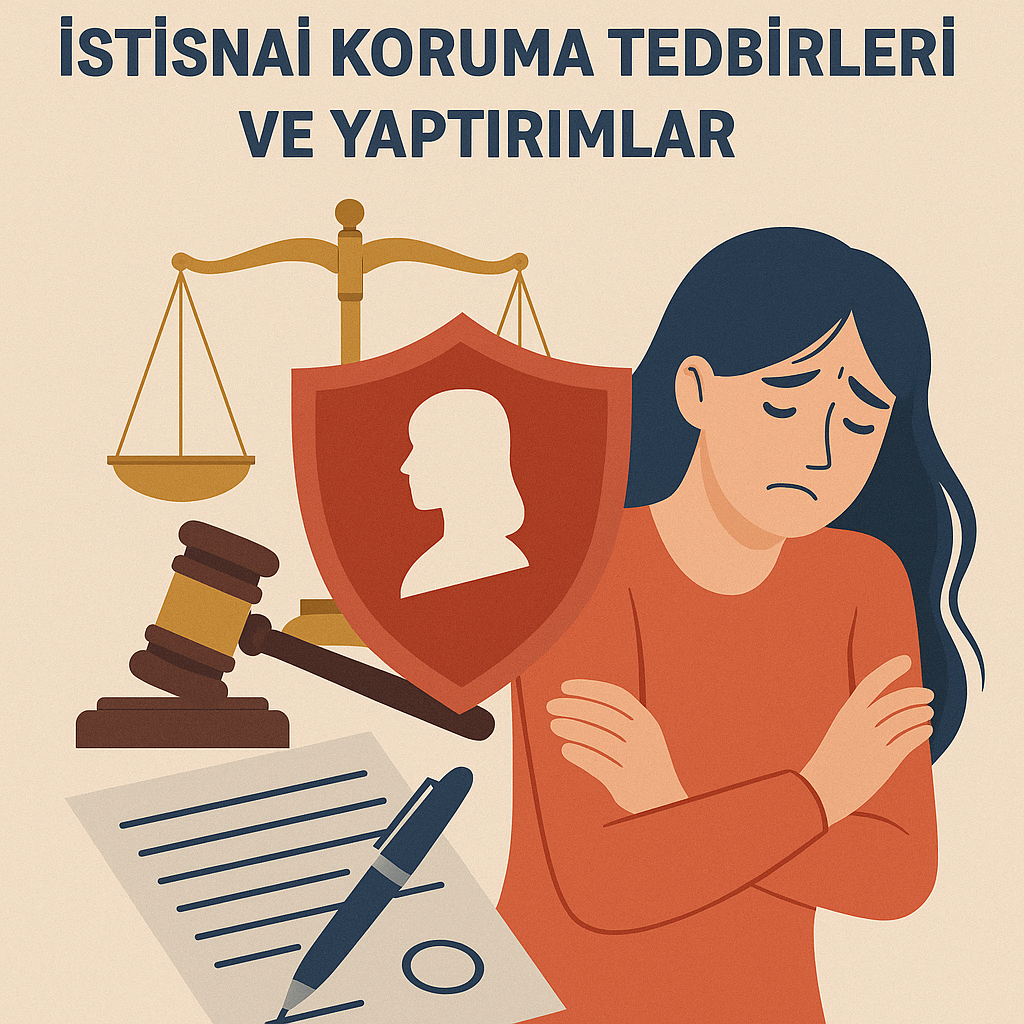
Exceptional Protective Measures and Sanctions in Crimes of Violence Against Women
ENTRANCE
Violence against women has become a priority area of struggle in both national and international law. Turkey has enacted numerous legal and administrative regulations to combat gender-based violence, most notably Law No. 6284; and has introduced exceptional provisions and aggravated penalties in the Turkish Penal Code (TCK) and related legislation to protect women victims of violence. It is now accepted by legal practitioners that violence is not limited to physical assault but is a multifaceted phenomenon encompassing psychological, economic, and sexual violence; consequently, protective and preventive measures and sanctions against perpetrators are increasingly featured in judicial decisions.
EXAMPLE OF A CONCRETE CASE
Ayşe Y. has been constantly harassed by her ex-husband, Mehmet Y., through phone calls, threatening and insulting messages on social media, and occasionally followed in front of her workplace since their divorce. One day, Mehmet Y. came to Ayşe Y.'s house, forced his way in, and threatened her, saying, "I won't leave you alone, I won't let you be with anyone else." Following this incident, Ayşe Y. contacted law enforcement, filing a complaint against Mehmet Y. and requesting a protective order under Law No. 6284.
LEGAL REGIME AND PROTECTION MEASURES IN VIOLENCE AGAINST WOMEN
1. Exceptional Protective Measures Introduced by Law No. 6284
Law No. 6284 on the Prevention of Violence Against Women has introduced significant innovations to Turkish law in favor of women and family members who are victims of violence. Under this law, the following preventive and protective measures can be taken immediately by the judge, upon the request of the victim or ex officio:
-
The perpetrator of violence must be removed from the victim, immediately expelled from the shared residence or place of residence, and prevented from approaching the victim (Article 5)
-
Prohibition of harassing the victim through communication tools
-
The victim's identity and address information will be kept confidential when necessary
-
Temporary financial assistance, psychological support, and shelter
-
Confiscation of his weapon and carrying permit
These measures can be implemented “without requiring evidence or documentation” and “immediately.” In case of violation of the decision, the offender will also be subject to disciplinary imprisonment.
2. Aggravated Penalties in the Turkish Penal Code
Under the Turkish Penal Code, penalties are increased depending on the type of violence against women and the victim's situation
-
The victim of the crime of intentional bodily harm must be the spouse or former spouse (Turkish Penal Code Article 86/3-a)
-
In cases of threats, insults, disturbing the peace, and stalking, the penalty may be increased or the investigation may be removed from the scope of complaint for victims who are "former spouses or divorced spouses"
-
Aggravating circumstances in sexual assault, harassment, and abuse crimes
In judicial practice, the Court of Cassation emphasizes that sentences given to perpetrators should be interpreted very narrowly, deviating from the lower limit and granting sentence reductions and discretionary reductions.
3. Other Relevant Regulations and Practices
At the international level, the Istanbul Convention, constitutional rights, victim protection provisions in the Code of Criminal Procedure, witness protection, and exceptional provisions such as confidential trials provide for the protection of women who are victims of violence.
COMPLAINT LETTER
I would like to state that the systematic threats, insults, and physical stalking directed at me have made my life unbearable. Mehmet Y. has been constantly harassing me via social media and telephone, following me in front of my workplace, and most recently, he came to my residence, tried to force his way in, and threatened me by saying, "I won't let anyone have you." These actions have endangered my life and caused me significant psychological harm. Therefore, I request that the suspect be punished in accordance with the relevant articles of the Turkish Penal Code, and that immediate protective measures be issued under Law No. 6284.
DEFENSE PETITION
The allegations of systematic violence and threats against the complainant by my client do not reflect the truth. Apart from some arguments stemming from their former marital relationship, my client has not engaged in any act of insult, threat, or physical violence against the complainant. Specifically regarding the alleged incident of forced entry, my client happened to be visiting an acquaintance in the same apartment building that day. The argument escalated upon encountering the complainant; however, there was absolutely no threat or violence involved. My client states that the complainant's allegations are abstract and unfounded, and that the application of protective measures would unfairly restrict their life and professional relationships. Therefore, we request that no protective measures be issued for my client and that a decision be made to dismiss the case.
CONCLUSION
Violence against women is not only a societal wound but also a serious human rights violation. The implementation of special protection mechanisms and aggravated penalties in Turkish law for crimes against women demonstrates the sensitivity of the judiciary and legislature on this issue. Thanks to the amendments made to Law No. 6284 and the Turkish Penal Code, the victim's statement is taken as the basis, protective measures are implemented promptly without requiring evidence, and deterrent sanctions are imposed on the perpetrator. In practice, however, a delicate balance must be struck between the protection of the victim and the perpetrator's right to a fair trial. The Supreme Court, meticulously evaluating the specifics of each case, prioritizes both the protection of the victim and the prevention of unjust protective measures.
Supreme Court Decisions
-
The 12th Criminal Chamber of the Court of Cassation, Case No. 2022/3416 E., Decision No. 2022/8276 K., dated December 22, 2022, stated:
“In protection orders issued under Law No. 6284, the victim's statement is sufficient; a decision should be made promptly without seeking evidence or documents, and if the perpetrator fails to comply with the order, disciplinary imprisonment should be applied.” -
The 4th Criminal Chamber of the Court of Cassation, Case No. 2020/4964 E., Decision No. 2021/3276 K., stated:
“In cases where the act of threatening and insulting a divorced spouse is proven, no discretionary reduction should be applied to the sentence given to the perpetrator, and the sentence should deviate from the lower limit. It is essential for the sake of public order that judicial authorities apply deterrent penal sanctions in cases of violence against women.” -
The 2nd Criminal Chamber of the Court of Cassation, Case No. 2019/8352 E., Decision No. 2020/3456 K.,
ruled: “The conviction of the defendant, who came to the complainant's house, forced open the door, and made statements to the complainant such as 'I will kill you, I will not leave you alone,' for the crime of threat under Article 106 of the Turkish Penal Code, and the decision to continue the protective measure under Law No. 6284, are in accordance with procedure and law.”


About Post Author
