
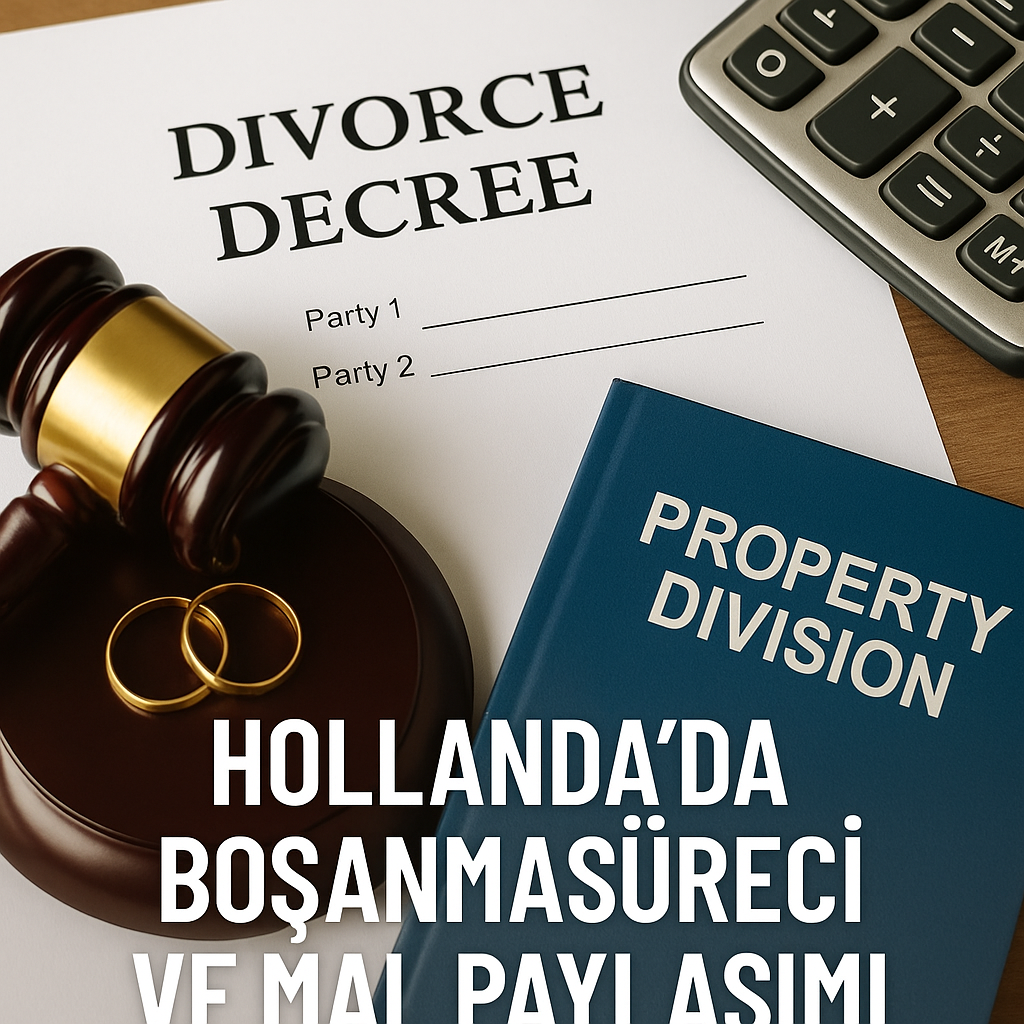
DIVORCE PROCESS AND PROPERTY DIVISION IN THE NETHERLANDS
Divorce and Property Division in the Netherlands – A Comprehensive Guide to 2025
1. Introduction
The Netherlands is one of the countries with a developed and systematic structure in the field of family law. The divorce process is regulated in Book 1 of the Dutch Civil Code ("Personen- en familierecht"), also known as the Burgerlijk Wetboek (BW) . Divorce is not only the formal termination of the marriage; it is a multifaceted legal process encompassing the liquidation of the property regime, child custody, alimony, and the rearrangement of property relations.
This article grounds for divorce, litigation and settlement procedures, property division, child custody, alimony, divorce of foreigners , and international recognition and enforcement procedures . Furthermore, practical examples will be presented by comparing practices in the Netherlands and Turkey.
2. Legal Grounds
Divorce proceedings in the Netherlands are based on the following legislation:
-
Burgerlijk Wetboek (BW) – Civil Code
-
Book 1: Family Law (Personen- en familierecht)
-
Specifically, Articles 150–283 concerning divorce and separation provisions.
-
-
Wetboek van Burgerlijke Rechtsvordering – Code of Civil Procedure
-
Article 261 and subsequent articles (Divorce procedure)
-
-
Internationale regelingen
-
Brussels II Regulation (EU 2019/1111) – International jurisdiction, recognition and enforcement
-
The Hague Convention on Child Abduction
-
-
ECLI:NL court decisions (Hoge Raad der Nederlanden – Dutch Supreme Court)
3. Reasons for Divorce
In Dutch law, divorce is based on the principle of irreparable breakdown of marriage ( duurzame ontwrichting van het huwelijk ) rather than on the principle of fault
-
Duurzame ontwrichting: This is the situation where the parties no longer have the possibility of continuing the marriage, and the marital bond has effectively ended.
-
"Fault" is not a requirement for proof; a statement from one of the parties is sufficient (ECLI:NL:HR:1990:ZC4189).
4. Types of Divorce
4.1. Consensual Divorce (Echtscheiding met wederzijds goedvinden)
-
The parties reach an agreement on divorce, property division, child custody, and alimony.
-
A single petition is submitted to the family court.
-
Results are typically obtained in 4-6 weeks.
4.2. Contested Divorce (Echtscheiding op tegenspraak)
-
If an agreement cannot be reached, legal action will be taken.
-
The process can take between 6 months and 1.5 years.
5. The Divorce Process Step by Step
5.1. Requirement to have a lawyer
-
In the Netherlands, an advocaat (lawyer) is required to file for divorce
5.2. Filing a Lawsuit (Verzoekschrift)
-
An application is made to the family court.
-
The petition includes the grounds for divorce, arrangements regarding children, and requests for property division.
5.3. Provisional Measures (Voorlopige Voorzieningen)
-
Who will stay at home?
-
Temporary alimony
-
Temporary custody of children
5.4. Court Decision and Population Registry
-
Once the decision is final, it is entered into the BRP (Bevolkingsregister)
-
The date of the decision is the date on which the divorce legally took place.
6. Property Regimes
6.1. Before January 1, 2018
-
In full community ownership (algehele gemeenschap van goederen)
, all property (including that acquired before marriage) is considered common property.
6.2. After January 1, 2018
-
In limited community property (beperkte gemeenschap van goederen),
property acquired before marriage remains personal; property acquired during marriage becomes common property.
6.3. Marriage Contract (Huwelijkse Voorwaarden)
-
The parties may change their property regime in the presence of a notary public.
7. Division of Property
7.1. Real Estate
-
Cadastral records are used as the basis.
-
The house can be sold or transferred from one spouse to the other.
7.2. Bank and Investment Accounts
-
Things acquired during marriage are shared.
-
Individual pension funds (pensioenrechten) are also taken into consideration.
7.3. Company Partnerships
-
If acquired during marriage, it can be considered joint property.
8. Sharing the Debt
-
Joint debts are divided equally.
-
Only the indebted spouse is responsible for personal debts.
9. The Situation of the Children
9.1. Custody (Ouderlijk Gezag)
-
Joint custody is the principle.
-
The court may grant sole custody if the child's best interests so require.
9.2. Child Support (Kinderalimentatie)
-
It is calculated using the Tremarapport formula.
-
Income, expenses, and standard of living are taken into consideration.
10. Marital Alimony (Partneralimentatie)
-
It is paid to the spouse who is unable to support themselves after a divorce.
-
A maximum of 5 years after 2020 (excluding exceptions).
11. Divorce of Foreigners
-
If one of the parties resides in the Netherlands, the Dutch courts have jurisdiction.
-
Divorce decrees of Turkish citizens are valid in Türkiye only after recognition and enforcement.
12. Tax and Financial Consequences
-
Taxes that may arise from the division of property (e.g., overdrachtsbelasting)
-
Tax exemptions in some cases
13. Alternative Dispute Resolution Methods
-
Mediation
-
Mediation
14. Risks and Recommendations
-
An asset assessment should be carried out.
-
Rights should be protected by a prenuptial agreement.
-
Expert assistance should be sought in contested lawsuits.
15. Conclusion
Although the divorce process in the Netherlands is transparent and systematic, it requires detailed legal knowledge and professional support, particularly regarding property division and children's rights. Incorrect strategies can lead to serious loss of rights.


About Post Author
