
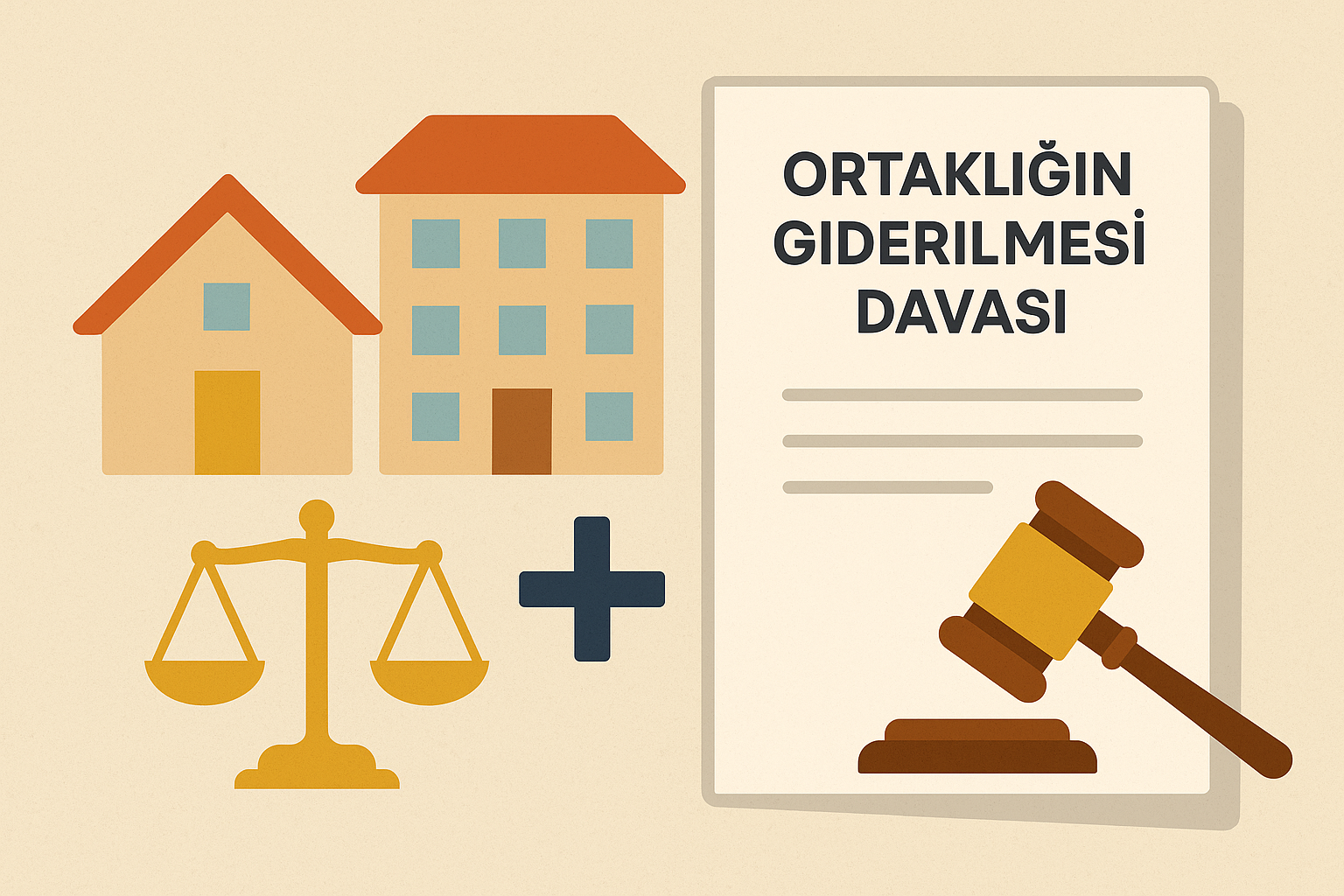
Partition Lawsuit (Izale-i Şuyu): Conditions, Process, and Supreme Court Decisions
In Turkish law, it is quite common for a real or movable property to be jointly owned by more than one person. However, this joint ownership does not always continue harmoniously for the parties. One co-owner may wish to freely use their share, but may experience disagreements with the other co-owners. In such cases, a lawsuit for the dissolution of joint ownership, also known as a partition lawsuit, comes into play.
This article provides comprehensive answers to questions such as what is a dissolution of partnership lawsuit, what are its conditions, how does the lawsuit process work, what methods are used to conclude it, and what points should be considered in light of Supreme Court decisions
What is Dissolution of Joint Ownership (Izale-i Şuyu)?
Dissolution of co-ownership is the termination of a joint ownership of a property, upon the request of any of the co-owners, when multiple individuals hold ownership rights over that property.
-
Joint Ownership (Co-ownership): Each co-owner has a specific share. This is often seen, for example, in properties inherited through inheritance.
-
Joint Ownership (Co-ownership): Shares are not defined; this particularly arises in inheritance partnerships.
In these types of ownership, the partnership can be terminated at any time upon the request of either party.
Legal Basis
-
Turkish Civil Code Articles 698-699: Each co-owner may request the dissolution of the partnership at any time.
-
Turkish Civil Code Article 642 and subsequent articles: The same right is granted in joint ownership.
-
Article 4 of the Code of Civil Procedure: Cases for the dissolution of partnerships are heard in the Civil Court of Peace.
Characteristics of a Partnership Dissolution Lawsuit
-
Any Stakeholder Can File a Lawsuit: Even if only one partner files the lawsuit, the approval of the others is not required.
-
No Statute of Limitations: It can be opened at any time as long as the partnership continues.
-
Can be filed for immovable or movable property: Although most commonly seen in immovable property, it is also possible for movable property.
-
Exclusive Jurisdiction Exists: In real estate cases, the lawsuit is filed in the Civil Court of Peace in the location where the property is situated.
-
The court decides by partition or sale: Based on the principle of divisibility, either partition in kind is carried out or the partnership is terminated through sale.
Conditions for a Lawsuit for the Dissolution of a Partnership
-
There must be shared or joint ownership involved .
-
One of the stakeholders must request the dissolution of the partnership
-
The lawsuit should be directed at all stakeholders.
Methods of Dissolving Partnerships
1. Exactly like Taksim (De facto division)
-
If the immovable property is divisible, it is physically divided and delivered to the co-owners in proportion to their shares.
-
For example, dividing a large plot of land into smaller plots.
-
According to the Supreme Court, if the immovable property is suitable for division in kind, then sale is not permissible.
2. Sharing Through Sales
-
If the immovable property is indivisible (for example, an apartment), it is sold through auction.
-
The sale price will be distributed among the shareholders in proportion to their shares.
-
The sale is usually the Enforcement Office .
The Case Process
-
Filing the Lawsuit: One of the stakeholders files a lawsuit in the Civil Court of Peace.
-
Inclusion of All Stakeholders in the Case: The court requires all partners to be a party to the case.
-
Expert Examination: An expert will prepare a report on whether the property is divisible.
-
Decision: If it is divisible, it will be divided in kind; otherwise, it will be sold.
-
Sale and Distribution: The sale proceeds are distributed to the shareholders, and the partnership ends.
Dissolution of Partnership in Light of Supreme Court Decisions
-
Supreme Court 14th Civil Chamber, Case No. 2017/3526, Decision No. 2019/4312: “In a lawsuit for the dissolution of co-ownership, if the immovable property is suitable for division in kind, sale cannot be resorted to.”
-
Supreme Court 8th Civil Chamber, Case No. 2016/4762 E., Decision No. 2018/8521 K.: “In joint ownership, a judgment cannot be rendered without including all co-owners in the lawsuit.”
-
Supreme Court Grand Chamber, Case No. 2015/12-1207, Decision No. 2017/1251: “Even if one of the co-owners waives their right, the lawsuit continues upon the request of the other co-owners.”
Shareholder Rights in a Partnership Dissolution Case
-
Stakeholders can participate in the sale and purchase the property.
-
The sale proceeds will be distributed to shareholders in proportion to their shares.
-
In the case of partition, each person becomes the sole owner of their allocated share.
The Role of the Lawyer in a Partnership Dissolution Case
These cases are heavily technical. Incorrect filings, failure to object to expert reports within the prescribed time, or the exclusion of all stakeholders from the lawsuit can lead to serious losses of rights. Therefore, having an expert lawyer manage the process ensures both a swift resolution of the case and the protection of the stakeholders' rights .
A partition lawsuit (izale-i şuyu)is one of the most important legal avenues for ending co-ownership of immovable properties held in shared or joint ownership. The law has always granted this right to co-owners.
The court will decide on either in kind or division through sale, . Therefore, before filing a lawsuit, the nature of the property, its market value, and the interests of the parties should be carefully evaluated; professional legal advice should be sought.


About Post Author
