
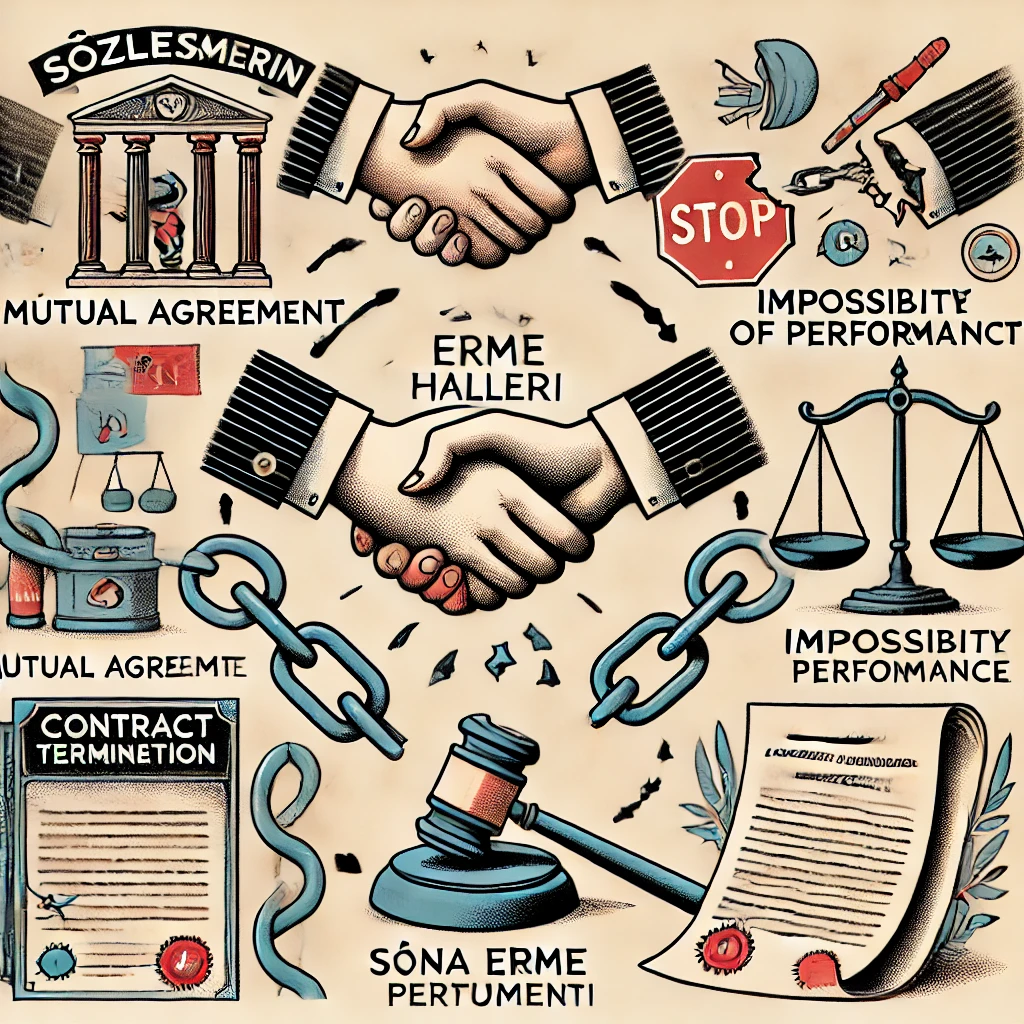
CONTRACT TERMINATION CIRCUMSTANCES: RELEASE, RENEWAL, IMPOSSIBILITY OF PERFORMANCE, AND OTHER REASONS
Contract Termination Circumstances:
Contracts are agreements that establish a legal relationship between parties, creating specific rights and obligations. However, every contract can be terminated by the parties fulfilling their mutual obligations or for other specific reasons. Termination of a contract means the legal cessation of the obligation to perform an act. When the principal obligation ends, the rights and obligations associated with it also end. Contracts can be terminated for specific reasons or at the discretion of the parties. These circumstances may vary depending on the type of contract, the contractual provisions, and legal regulations. The circumstances under which contracts may terminate are as follows:
- Release from Obligation: An agreement between parties to release the debtor from their debt without requiring performance of the obligation. Since a release is an agreement, the debt continues unless the debtor accepts the release. The parties may also agree to terminate the contract, partially or completely. In release agreements, unless otherwise stipulated, the release is considered to cover the entire debt.
Conditions for the Validity of the Release:
- It must have been done with the free will of the parties.
- The agreement must include a clear declaration of intent to terminate the contract.
- The agreement must be in the mutual interests of both parties.
- Renewal (renewal): Renewal is the termination of a previous debt by creating a new debt through a change in the subject matter, applicable provisions, cause, or parties involved. For a new debt to be created and an existing debt terminated, the explicit intention of the parties is required. Renewal is possible through agreement between the parties. The new debt resulting from renewal has an independent legal entity. Even if the old debt was subject to a different statute of limitations, the new debt is subject to a ten-year statute of limitations.
- Merger of creditor and debtor roles: If the creditor and debtor roles are combined in the same person, the debt is extinguished.
- Impossibility of Performance: If the performance of the contract becomes impossible due to reasons for which neither party can be held responsible, the contract terminates. After the obligation becomes impossible due to reasons for which the debtor cannot be held liable, the debtor must notify the creditor of the impossibility of performance without delay and attempt to prevent further damage; otherwise, they will be held responsible for the resulting damage.
Types of Impossibility of Performance:
- Objective Impossibility: Situations where no one can fulfill the obligation (e.g., the complete destruction of the property).
- Subjective Impossibility: Situations where only the debtor is unable to perform the obligation (for example, the debtor's inability to fulfill the obligation due to personal reasons).
-
- Set-off: A unilateral act by which one party, holding a claim of the same type against another, terminates their claim to the lesser amount. The conditions for a set-off are: both parties must be both debtors and creditors; the performance constituting the subject matter of the claims must be of the same type; the party requesting the set-off must be ready to perform the claim; and the set-off must not have been waived.
- Performance (Execution) of the Contract:The contract terminates when both parties have fulfilled their obligations and responsibilities completely and on time. In this case, all obligations arising from the contract are considered fulfilled, and the contract automatically terminates.
- Fulfillment of Condition: The contract terminates when a condition stipulated as the termination condition is met. In such contracts, the contract terminates automatically upon the occurrence of a specific event.
- Compensation or Penalty Clause: If the other party suffers damage due to breach of contract, the contract shall terminate upon compensation for the damage or fulfillment of the penalty clause.
Types of Penalty Clauses:
- Penalty for Breach of Contract: Compensation paid in case of breach of contract.
- Substitute Penalty: A penalty imposed in cases where performance is impossible.
- Late Payment Penalty: A penalty paid if payment is not made within the specified time frame.
- Exercise of Rights Creating New Conditions: This occurs when one party terminates a contract by exercising a specific right stipulated in the contract.
Types of Rights that Give Rise to Innovation:
- Right of Withdrawal: The right of either party to unilaterally terminate a contract.
- Extension of Contract Term: In fixed-term contracts, the parties have the right to extend the term.
The termination of contracts means the cessation of the mutual rights and obligations of the parties, and this can occur in many different ways. Performance, termination, expiration of term, mutual agreement, death, and impossibility of performance are the basic circumstances leading to the termination of a contract. These circumstances are of great importance in terms of ending legal relationships and releasing the parties from their obligations. Each type of termination has different consequences in legal proceedings and plays a critical role in protecting the rights of the parties.
Law Student Intern Nursena İbanoğlu


About Post Author
