
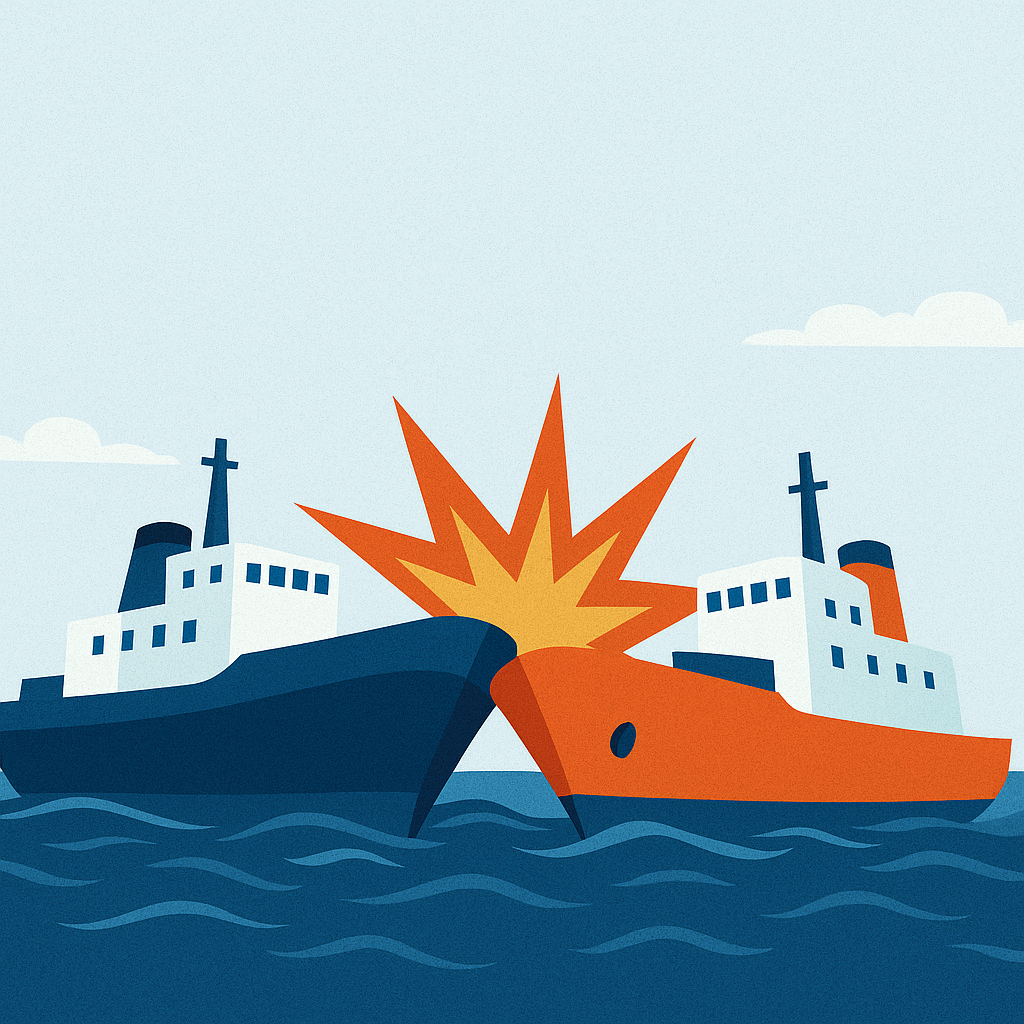
Joint Fault Collision in Maritime Law: Fault Ratio, Liability and Compensation
Common fault collision in maritime law
Joint Collision in Maritime Law: Legal Framework and Application
1. Introduction
The maritime sector is a strategic transportation area carrying over 80% of world trade. However, these activities, carried out in international waters and coastal areas, also bring with them natural risks and dangers stemming from human factors. One of these risks ship collisions. A collision is not limited to physical damage; it gives rise to multifaceted legal consequences, including life safety, environmental protection, cargo liability, insurance relationships, and costly compensation claims.
the Turkish Commercial Code (TTK) and the 1910 Brussels Convention on Collision, collision cases are divided into three main categories:
-
A clash due to the fault of one side,
-
Flawless assembly,
-
Common fault collision.
A collision with shared fault refers to situations where both parties share a certain degree of fault in causing the collision. Determining the percentages of fault, sharing compensation liabilities , and exercising insurance subrogation rights requires a complex legal process. In particular, COLREG (Collision Avoidance Rules at Sea) violations, technical defects, and human error are the most common elements in collisions with shared fault.
In practice, such cases require consideration not only of the provisions of the Turkish Commercial Code but also of international conventions, established maritime customs, Supreme Court precedents, and technical expert reports. Therefore, it is vital for lawyers, shipowners, insurance companies, and maritime businesses dealing with maritime trade law to have a comprehensive understanding of all aspects of the issue of collisions caused by negligence
2. Legal Basis
Article 1280 of the Turkish Commercial Code regulates the liability regime to be applied in cases of collisions caused by joint fault. According to this article:
- If the collision occurred due to the combined fault of both vessels, the parties are liable for the damages in proportion to the severity of their fault.
- If the percentages of fault cannot be determined, the parties shall be held equally responsible for the damages.
Furthermore, Article 4 of the 1910 Brussels Convention on Collisions similarly states that when both parties are at fault, liability shall be shared in proportion to their degree of fault.
3. The Concept of Fault and Identification of Common Fault
In maritime law, fault COLREG (Codes for Preventing Collisions at Sea), the provisions of the Turkish Commercial Code, and the requirements of the maritime profession. In determining joint fault, courts consider the following factors:
- Whether navigation rules were followed (e.g., course change, right of way)
- Speed limits (speed appropriate to weather and sea conditions)
- Obligation to observe (providing sufficient observers, actively using radar and AIS systems)
- Obligation to intervene (to maneuver in a timely manner to prevent danger)
For example, if one ship has failed to comply with navigation regulations and the other has failed to perform an evasive maneuver in time, both ships will be considered at fault.
4. Determining the Amount of Compensation
Determining compensation in collisions involving shared fault is one of the most technical and sensitive aspects of maritime law. Article 1280 of the Turkish Commercial Code , the degree of fault directly affects the parties' obligation to bear the damages.
-
If the Fault Percentage Can Be Determined: Each party is only liable for the damages corresponding to their own percentage of fault. For example, if ship A is 70% at fault and ship B is 30% at fault, each party will only pay the other party the amount of damages corresponding to that percentage.
-
If the Fault Rate Cannot Be Determined: Damages are shared equally. This usually occurs when the technical records of the incident are insufficient, radar/AIS data is missing, or contradictory.
The range of compensation items is quite extensive:
-
Ship Repair Costs: Shipyard fees, parts replacement costs, drydocking fees, technical service expenses.
-
Cargo Damage: The decrease in value resulting from partial or total damage, deterioration, or loss of cargo.
-
Loss of Hire: Loss of charter or freight due to the vessel being out of service.
-
Salvage and Evacuation Costs: The expenses incurred to transport the vessel to a safe port after a collision.
-
Damages to Third Parties: For example, compensation for damages to another vessel, port facility, or the environment resulting from a collision.
During the calculation process, courts obtain technical review reports from expert panels and take into account international marine insurance standards (Lloyd's, P&I, etc.).
5. Burden of Proof
In jointly liable collision cases the burden of proofrests with the party making the claim, in accordance with Article 190 of the Code of Civil Procedure. However, in the maritime field, the importance of technical evidence is much greater.
-
Liability of Each Party: The parties bear the burden of proving that the other party is at fault. This is often based on technical evidence.
-
Main Evidence:
-
Radar and AIS Records: Information on the speed, course, and position of ships.
-
Logbook: Records kept by the ship's captain and crew at the time of the incident.
-
Port Authority and Coast Guard Reports: Official findings made after the accident.
-
Witness Statements: Testimonies from crew members, other ship personnel, or port officials.
-
Expert Reports: Compliance reviews with the Rules for Preventing Collisions at Sea (COLREG).
-
COLREG violationsgive rise to a presumption of fault. For example, failure of a vessel with right of way to yield or performing a dangerous maneuver is considered direct fault. To refute this presumption, the party must present legal grounds such as "unavoidability" or "necessity".
6. Insurance and Subrogation Rights
In collisions involving mutual fault, the insurance mechanism plays a critical role in balancing the burden of compensation. Two main types of insurance are commonly used in the maritime sector:
-
P&I (Protection & Indemnity) Insurance: Covers areas such as cargo, third-party damage, environmental pollution, and crew compensation.
-
Hull & Machinery (H&M) Insurance: Covers physical damage to the hull and machinery of the vessel.
Insurance companies their right of recourse .
-
Recourse in Case of Joint Fault: The insurance company has the right to seek recourse from the other party or their insurer for the portion of the compensation paid that corresponds to their degree of fault.
-
Insurance Coverage Limits: Policies generally include specific limits; damages exceeding these limits are covered from the parties' own assets.
Furthermore, even if the majority of the damage resulting from a collision is covered by insurance, insurance exclusions (e.g., war risk, intentional acts of the crew) may apply. In these cases, the parties involved bear direct liability.
7. Application in Light of Supreme Court Decisions
- The 11th Civil Chamber of the Supreme Court of Appeals, in its decision numbered 2018/3910, stated that expert reports must be supported by technical data when determining fault percentages, and that decisions cannot be made solely based on witness testimony.
- The 11th Civil Chamber of the Supreme Court of Appeals, Case No. 2021/4761, ruled that in collisions where both parties are at fault, if one of the parties proves that the degree of fault cannot be determined, the damages shall be equally divided.
8. Conclusion
Joint collisionis one of the most complex areas of dispute in maritime law. Because both technical and legal aspects are intertwined in such cases, managing the process should be handled by experienced maritime lawyers and expert consultants.
In cases of shared fault:
-
Objectively determining fault percentagesis critical to ensuring justice.
-
Article 1280 of the Turkish and of the 1910 Brussels Collision Convention constitute the fundamental reference points in the sharing of liability.
-
Compliance with COLREG rulesplays a vital role in both preventing collisions and minimizing fault in potential lawsuits.
-
Understanding the scope of insurance policies and subrogation rights is an important strategy for reducing financial burdens for shipowners and businesses.
In practice, the rapid collection of evidence (radar/AIS records, logbook, port reports), supporting expert examinations with technical data , and legal strategies in accordance with international standards increase the likelihood of a favorable outcome.
Furthermore, a preventive legal approach should be adopted for all businesses operating in the maritime sector . Regular staff training , emergency drills , ship maintenance programs , and legal advice services reduce the risk of collisions and minimize the burden of compensation in the event of a potential accident.
Gozdenur Turna


About Post Author
