
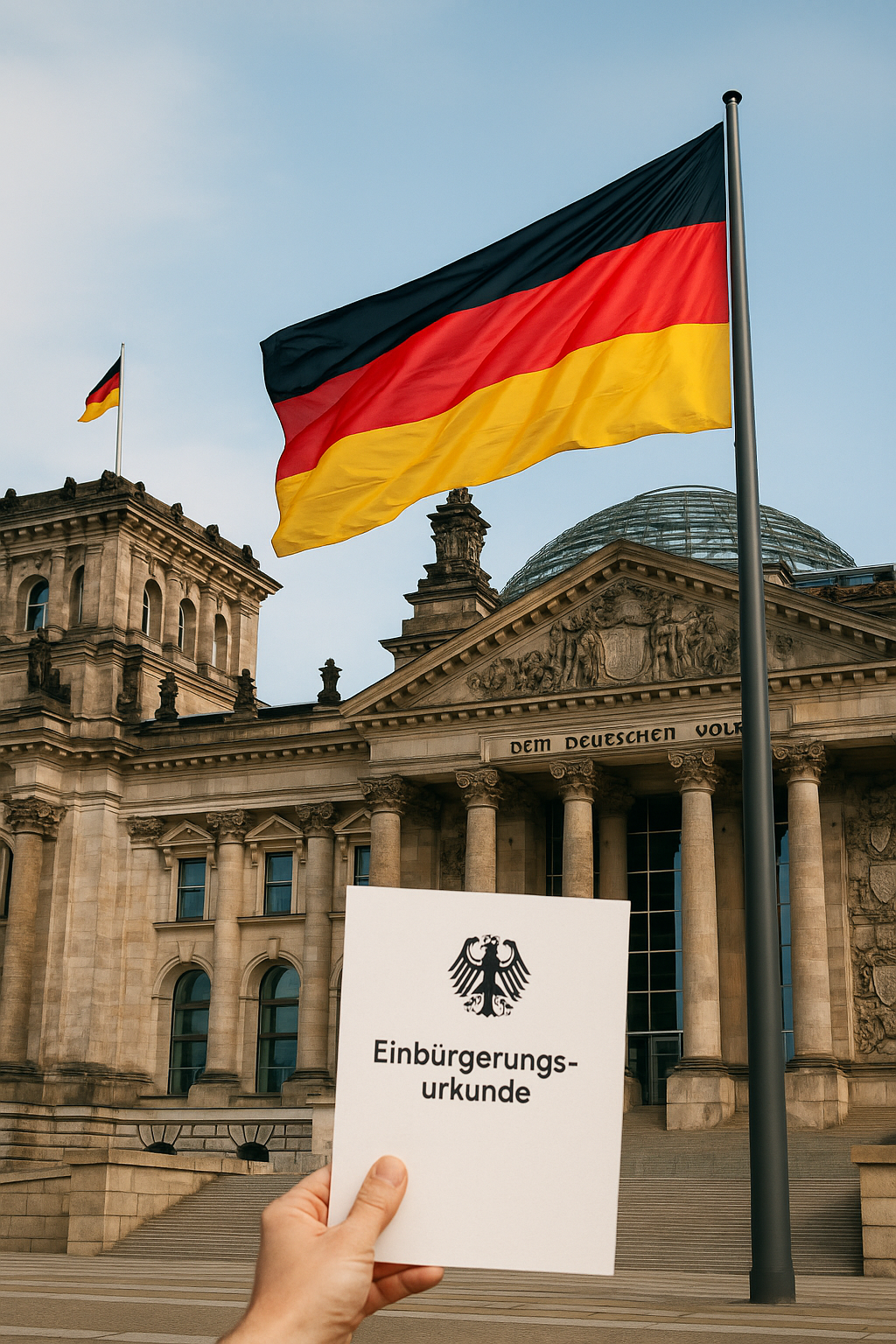
Acquisition of German Citizenship through General Naturalization
Entrance
Germany has made significant changes to its citizenship law with comprehensive reforms that came into effect in 2024. These reforms aim, in particular, to accelerate the integration of individuals of immigrant origin and to facilitate the acquisition of citizenship by those who have been living in Germany for a long time. In this context, of general naturalization (Einbürgerung) is one of the primary legal avenues for obtaining German citizenship.
This article will detail the legal basis, conditions, process, and current changes in practice for acquiring German citizenship through general naturalization.
I. Legal Grounds
The general naturalization process is primarily the German Citizenship Act (Staatsangehörigkeitsgesetz – StAG) . This law governs how a person can acquire German citizenship by birth, lineage, marriage, or application (Einbürgerung).
With the reform law adopted in 2024 and entering into force on June 27, 2024, the changes made to the StAG brought about fundamental innovations in the following areas:
-
Reducing the residency period from 8 years to 5 years,
-
For those who successfully integrate, this period should be reduced to 3 years
-
Lifting the ban on dual citizenship,
-
Allowing flexibility in citizenship tests and language proficiency certificates.
II. General Naturalization Requirements
Individuals wishing to acquire German citizenship through general naturalization must meet the following objective and subjective conditions:
1. Permanent Residence and Duration Requirement
Applicants for German citizenship must have resided legally and continuously in Germany for at least five years . This period can be reduced to three years depending on the applicant's level of integration .
Note: This period, previously 8 years, has been reduced to 5 years with the 2024 reforms. This indicates that the aim is to facilitate faster integration of immigrants into society.
2. German Language Proficiency
Applicants must have at least a B1 level of German language proficiency. This proficiency must be documented with certificates from recognized institutions such as the Goethe Institute, TELC, or ÖSD. For those who demonstrate successful integration, a C1 level reduces the processing time to 3 years.
3. Economic Independence
The individual must be able to support themselves and, if applicable, their family. In this context, it is essential that they are not receiving social assistance (such as ALG II) or social support (Sozialhilfe). However, exceptions may be granted in cases of short-term unemployment.
4. Having a clean criminal record
One of the most important subjective criteria for naturalization is criminal record. Serious crimes, organized crime, or acts related to terrorism are obstacles to naturalization. Minor fines may not be an obstacle in some cases, but a detailed assessment will still be conducted.
5. Citizenship Test
Applicants the citizenship test (Einbürgerungstest), . At least 17 out of 33 questions must be answered correctly.
6. Declaration of Allegiance and Loyalty to Germany
The applicant declares that they accept Germany's liberal democratic order . This declaration is obtained in writing and is usually included among the application documents
7. Dual Citizenship
With the 2024 reform, dual citizenship is now permitted. The requirement to renounce previous citizenship is no longer necessary during the application process. This has provided a significant advantage, particularly for Turkish citizens.
III. Application Process
The naturalization process is an administrative procedure and is usually handled by the Einbürgerungsbehörde ( residents' office) in the state of residence
1. Application Documents
The main documents that must be submitted with the application are as follows:
-
Passport or valid identification document
-
Residence permit card
-
Residence certificate (Meldebescheinigung)
-
Language proficiency certificate
-
Income documents and employment contracts
-
Citizenship test result
-
Criminal record certificate (Führungszeugnis)
-
Declaration of allegiance to Germany
2. Application Fee
-
Application fee for adults: 255 Euros
-
For children (applying with a parent): 51 Euros
3. How long does the process take?
The application process typically 6 and 18 months . However, a complete and accurate application process can be faster.
IV. Problems Encountered in Practice and Judicial Decisions
In Germany, it is possible to appeal citizenship refusal decisions in administrative courts (Verwaltungsgericht) . Common reasons for refusal include:
-
Insufficient residence period,
-
Rap sheet,
-
Insufficient language proficiency,
-
Submitting misleading documents.
In a 2023 ruling, the Berlin Administrative Court rejected the citizenship application of an applicant who submitted a forged diploma, but ruled that the administration should reconsider the decision after the applicant subsequently submitted genuine documents.
V. Conclusion and Evaluation
The general naturalization system is fundamental to Germany's policies of integrating individuals of immigrant origin into society and making them part of the political community. The reforms of 2024, which eased the naturalization process, have brought about a significant transformation, particularly in Germany where a large number of Turkish citizens reside.
At this point, seeking legal assistance ensures that the application is prepared correctly, completely, and effectively. Citizenship is not only a legal status but also a sense of belonging and a right to political representation. Therefore, obtaining expert advice during the application process will prevent the loss of personal rights.


About Post Author
