
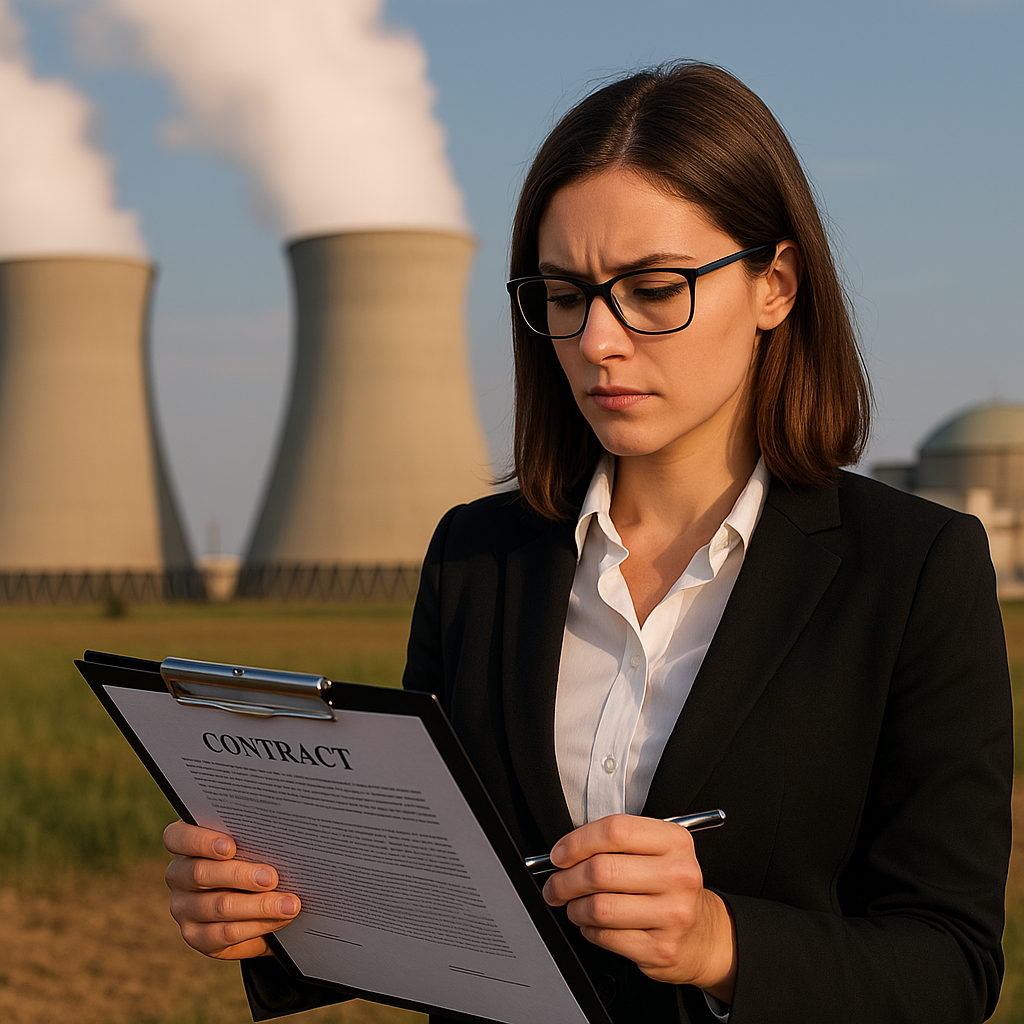
How do state guarantees and investor contracts work in nuclear energy projects?
Entrance
Nuclear energy projects are long-term and costly projects requiring high technology and large-scale investments. State guarantees and investor agreements are critical for the realization of these projects. Due to high construction costs, long payback periods, and political risks, state guarantees provide security for investors and play a decisive role in the financing and sustainability of the projects.
This article will examine how state guarantees and investor agreements operate in nuclear energy projects, considering legal frameworks, contract types, risk-sharing mechanisms, international practices, and practical challenges.
1. The Role of State Guarantees in Nuclear Energy Projects
1.1. What is a State Guarantee?
Government guarantees are legal assurances in which a government undertakes to assume certain risks or payments. In nuclear projects, these guarantees include:
-
To offset high investment costs (over $10 billion),
-
To secure long-term electricity sales revenue,
-
To reduce regulatory risks and political uncertainties,
-
It is used to provide financial security for waste management and facility decommissioning.
1.2. Types of State Guarantees
-
Payment Guarantees: The state guarantees that it will purchase the electricity produced by the nuclear power plant at a predetermined price (specifically through Energy Purchase Agreements – PPAs).
-
Loan and Debt Guarantees: The government guarantees the repayment of loans provided for the project.
-
Regulatory and Legal Stability Guarantees: Includes commitments that there will be no adverse changes to tax, tariff, and licensing regulations.
-
Decommissioning and Waste Management Guarantees: Support is provided to ensure the decommissioning of the plant at the end of its life and the disposal of radioactive waste.
2. Legal Basis of State Guarantees
State guarantees are generally regulated within the framework of energy law, public finance legislation, and investment laws
-
Law No. 5710 on the Establishment and Operation of Nuclear Power Plants is the fundamental legislation framing state support and investor relations in Türkiye.
-
Public-private partnership (PPP) models and investor-state agreements form the legal basis for guarantees.
-
The Energy Charter Treaty (ECT) and bilateral investment treaties (BITs) provide state protection for foreign investors.
Example: The Akkuyu Nuclear Power Plant Project in Türkiye is being carried out by Rosatom (Russia) and a long-term purchase guarantee (PPA) is provided by the Turkish government.
3. The Importance of Investor Agreements
3.1. What is an Investor Agreement?
Investor agreements are contracts between the state (or state-owned enterprises) and private investors in nuclear power plant projects, regulating the rights, obligations, and risks associated with the project. These agreements:
-
The financing structure,
-
Construction and commissioning schedule,
-
Electricity sales price and purchase conditions,
-
Fuel supply and waste management,
-
It specifies the conditions for force majeure and compensation.
3.2. Types of Contracts
-
Build-Own-Operate (BOO): The investor builds, owns, and operates the power plant (the Akkuyu Project is an example of this model).
-
Build-Own-Operate-Transfer (BOOT): After a certain period, the power plant is transferred to the state.
-
Joint Venture: Government agencies and private companies share ownership and operating rights.
4. Power Purchase Agreements (PPAs)
PPAs are long-term contracts that secure revenue streams for nuclear power plants. These agreements:
-
The electricity sales price (feed-in tariff),
-
The minimum amount of electricity to be purchased,
-
Price increases due to inflation,
-
It includes exchange rate protection.
In Türkiye, within the scope of the Akkuyu Project, a portion of the electricity produced is purchased by the state for 15 years at a predetermined price under a government guarantee.
5. Risk Sharing
Nuclear energy projects involve numerous risk factors. Sharing these risks in investor agreements is critical
-
Construction and Delay Risk: This risk is borne by the EPC (Engineering-Procurement-Construction) contractor or investor.
-
Operational Risk: Operational errors or technical malfunctions are generally the responsibility of the investor.
-
Political and Legal Risk: Managed by state guarantees or contractual stabilization clauses.
-
Force Majeure: Special compensation provisions exist for situations such as earthquakes, war, or nuclear accidents.
6. International Case Studies
6.1. Akkuyu Nuclear Power Plant (Türkiye)
Rosatom will build and operate the power plant using the BOO (Build-Operate-Transfer) model. The Turkish government has provided a 15-year purchase guarantee for 50% of the electricity produced.
6.2. Korean and French Models
-
Korea: KEPCO (state-owned energy company) plays a role as both an investor and operator in nuclear projects.
-
France: Through EDF (Électricité de France), the state provides direct investment and long-term price guarantees.
7. Dispute Resolution Methods
International arbitration is generally preferred in investor disputes.
-
ICSID Arbitration: Used to resolve disputes between foreign investors and governments.
-
ICC or LCIA arbitration: Preferred for commercial disputes.
Thanks to the New York Convention (1958), arbitration awards are recognized and enforceable in most countries.
8. Challenges in Government Guarantees and Investor Agreements
-
Budget Constraints: Government guarantees can place a burden on public debt and fiscal balances.
-
Political Volatility: Changes in government can create risks in long-term agreements.
-
Nuclear Legal Liability: Under the Paris and Vienna Conventions, the operator's unlimited and strict liability is reflected in investor agreements.
-
Environmental and Public Relations: Projects may be delayed due to environmental lawsuits and public backlash.
9. Risk Mitigation Strategies
-
Multilayered Guarantee Structures: In addition to government guarantees, insurance from institutions such as MIGA and Eximbank is added.
-
Stabilization Clauses: These provide protection for the investor against tax and regulatory changes.
-
Step-in Rights: The right of the financier or the state to intervene in the project.
-
Compliance with IAEA Standards: Nuclear safety is essential for the continuation of the operating license and guarantees.
10. Future Trends
-
ESG and Green Financing: Environmental, social, and governance (ESG) criteria are being integrated into the financing model for nuclear projects.
-
Small Modular Reactors (SMR): Investor agreements will be tailored to low-cost and scalable SMR projects.
-
Digital Contract Management: Blockchain and artificial intelligence will increase the transparency and traceability of agreements.
Conclusion
In nuclear energy projects, government guarantees and investor agreements are indispensable for both ensuring investor confidence and guaranteeing the long-term success of the project. In Türkiye, as seen in the Akkuyu example, the government's purchase guarantee and regulatory support have increased the interest of international investors in the project.
In the future, legal stability, international arbitration guarantees, and risk-sharing mechanisms will continue to play a decisive role in the decision-making processes of investors in nuclear projects.
Gamze Akbulut, Law Faculty Student


About Post Author
