
Vehicle Depreciation Claim
Definition and Legal Nature of Vehicle Depreciation
Vehicle depreciation is the objective and permanent difference between the pre-accident (second-hand) market value of a vehicle repaired due to a traffic accident and its resale value after repair. In other words, even if the vehicle is repaired flawlessly, the decrease in its value due to reduced reputation and demand in the second-hand market is the subject of compensation. For a vehicle depreciation claim to be valid, the accident causing the depreciation must have occurred bilaterally.
Vehicle depreciation is an actual loss. Actual loss is the objective difference between the state of the property if the damaging event had not occurred and its current state after the event. The aim of compensation is to restore the vehicle to its pre-accident economic condition as closely as possible. The driver and the operator/enterprise to which they are affiliated are jointly and severally liable for this loss. The injured party may seek recourse against any of them; in internal relationships, the payer has recourse against the others in proportion to their respective responsibilities.
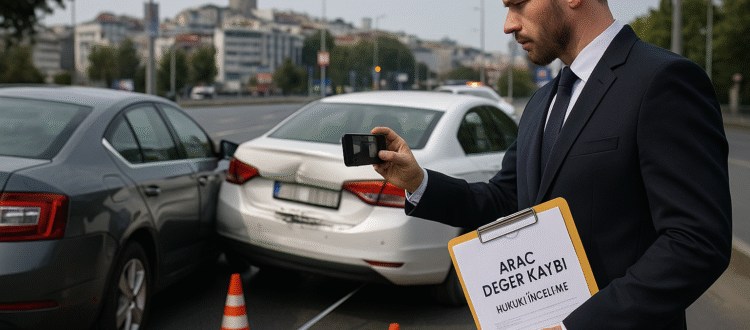
Liability of the Party Causing Damage
Article 90 of the Highway Traffic Law (KTK) states that the provisions of the Turkish Code of Obligations regarding torts (Articles 49 et seq. of the Turkish Code of Obligations) shall apply to compensation claims arising from depreciation in value. Liability for torts rests with the party causing the damage. For the party causing the damage to be liable for compensation, there must be an appropriate causal link between the accident and the resulting damage. The party causing the damage must be at fault, but complete fault is not required. When determining the amount of compensation, fault, the distribution of damages between the parties, and the contributory negligence of the injured party (Article 52 of the Turkish Code of Obligations) may be considered as mitigating factors. The judge, in accordance with Article 51 of the Turkish Code of Obligations, will make the assessment considering the circumstances of the event and the severity of the fault.
Operator's Responsibility
The operator title generally belongs to the person listed as the owner in the traffic registry. However, according to Article 3 of the Traffic Law, in cases such as long-term rentals of the vehicle, the lessee is considered the operator if delivery, actual control, maintenance/expenses, assumption of risks, and economic benefit are transferred to the lessee. In short-term rentals (rent-a-car applications), the operator title usually remains with the owner. What is decisive is not only the earning of profit, but also who actually operates the vehicle and who bears the risk.
The operator's liability for damages caused to third parties due to the operation of a motor vehicle is strict (dangerous) liability (Turkish Traffic Law, Article 85). The operator can only be relieved of liability or have their liability reduced if they prove force majeure, the gross negligence of the injured party, or the gross negligence of a third party (Turkish Traffic Law, Article 86). Fault primarily plays a role in recourse relationships between the operator and the driver/other responsible parties, and in reducing the amount of compensation in cases of contributory negligence on the part of the injured party (Turkish Code of Obligations, Article 52).
Insurance Companies' Liability
In terms of Compulsory Motor Vehicle Liability Insurance (CMV), the insurer covers the operator's liability under Article 85 of the Turkish Commercial Code (TCC) within the policy limit and coverage conditions (TCC Article 97; CMV General Conditions). Any amount exceeding the limit remains the responsibility of the operator/driver; however, if the vehicle has a Voluntary Financial Liability (VFL) policy, the VFL insurer may cover this portion within the framework of the policy provisions. The injured party may also directly apply to/file a lawsuit against the VFL insurer in accordance with Article 1478 of the Turkish Commercial Code; payments made under CMV are subject to offsetting, and the same damage cannot be compensated twice.
Can a claim for depreciation be filed if the vehicle is totaled?
Physical damage to a vehicle following a traffic accident is, as a rule, covered by repair costs. However, if the repair cost exceeds the vehicle's pre-accident market value, or if a safe repair according to manufacturer standards is not practically possible, the vehicle is considered a total loss; in practice, this is called a "total loss." Rather than being a legally defined term in legislation, "total loss" is an established expression used in insurance practice to describe vehicles that are severely/completely damaged and whose repair is not considered economically or technically rational. Indeed, courts, in order to determine the accuracy of this classification, compare the pre-accident market value with the necessary repair items (parts, labor, painting, etc.) due to the accident, through expert assessment, and determine whether an economically viable repair is possible.
If a vehicle is declared a total loss, it can no longer be sold on the used car market; in this case, a claim for depreciation is not applicable. Compensation is generally determined based on the market value of the vehicle at the time of the accident, and any salvage/depreciation value is deducted. However, if the vehicle is repaired and remains on the road and is suitable for sale, the permanent difference between its pre-accident and post-repair salvage value, i.e., the vehicle's depreciation, can be claimed separately. In short, depreciation is not claimed in cases where a total loss decision is made; however, if economically feasible repair is possible, depreciation is compensated as a separate loss item from the repair costs.
Application
Legal Action
If the injured party wishes to pursue legal action, they must first submit a written application to the insurance company. According to Article 97 of the Turkish Road Traffic Law, in claims under Compulsory Motor Vehicle Liability Insurance (ZMSS), submitting a written application to the relevant insurance company before filing a lawsuit is a prerequisite for litigation. If the insurer 15 calendar days , or if the response does not satisfy the claim, the injured party may file a lawsuit. Lawsuits filed without fulfilling this prerequisite will be dismissed on procedural grounds due to the lack of a prerequisite.
Arbitration Method
If the injured party chooses arbitration instead of litigation, the pre-application requirement also applies; however, according to Article 30/13 of the Insurance Law, the waiting period is 15 business days. If the insurer fails to respond to the request within 15 business days of the written application, or provides a negative/incomplete response, an application can be made to the Insurance Arbitration Commission.
Points to Consider
Determining the competent court
-
General rule: In property disputes, unless there is a specific regulation to the contrary, the competent court is the Civil Court of First Instance (Code of Civil Procedure, Article 2).
-
Claim for loss of value/compensation against the insurer (compulsory motor insurance): The dispute falls within the scope of insurance law; due to its nature as an absolute commercial case, the Commercial Court of First Instance has jurisdiction (Turkish Commercial Code Article 4; Supreme Court practice).
-
Tort compensation claims only against the driver/operator: The Civil Court of First Instance has jurisdiction.
- Cases where both the defendant and the plaintiff are merchants, even if based on tort law, in Commercial Courts .
-
Both the driver/operator and ZMSS are defendants in the case: Due to the connection and insurance elements, the case in the Commercial Court of First Instance .
-
Claims arising from a comprehensive car insurance policy against the insurer: As a rule, the Commercial Court of First Instance has; however, if the policyholder is a consumer and the transaction is a consumer transaction, the Consumer Court may have jurisdiction.
-
Rent-a-car and similar relationships: The Consumer Court if the party is a consumer ; the Commercial Court of First Instance if the relationship is commercial .
Determining the competent court
-
The place of the tort (place of accident) is the defendant's place of residence; for the insurer the court of the headquarters/branch location is also practically accepted.
-
If you have consumer status (in a comprehensive insurance/insurance relationship), the Consumer Court may become an alternative.
Statute of limitations
-
General rule: 2 years (before knowing the damage and the responsible party) and in any case 10 years; if the incident constitutes a crime, a statute of limitations for punishment may apply.
-
These timeframes are also guiding principles in arbitration applications.
Interest and Default
-
If a valid application to the insurer remains unanswered/unsatisfied within 15 days (judicial proceedings) / 15 business days (arbitration), then legal action will be taken
-
If the documents are complete and payment is not made within 8 business days of the application, the insurer will be in default ; interest may be requested to accrue from that date.
Calculation Criteria (Expert's Guidelines)
-
Vehicle age and mileage, nature of damage (paint/part replacement), number/location of replaced parts, damage history, market data.
-
Principle of depreciation due to repetition: Repeated repainting on the same panel does not, by rule, cause additional depreciation; part replacement causes depreciation because it compromises originality.
Evidence and Document Checklist
-
Accident report, damage photos, service/expertise records, TRAMER (Turkish Motor Vehicle Insurance Information System) report, list of replaced/painted parts, market value research, insurance policy, written application and responses, IBAN.
Possibility of Mandatory Mediation (Practical Warning)
- a lawsuit a commercial character , some jurisdictions mandatory mediation (Article 18/A of the Law on Civil Procedure).
-
The safest approach: First, file a written application, then mediation, followed by litigation/arbitration.
Final words
With a proper application, a solid set of evidence, and the right legal approach, vehicle depreciation can be effectively compensated. Managing the process with professional support ensures the best possible outcome by preventing errors in deadlines/conditions and calculation inaccuracies.
Student Gül DİLSİZ


About Post Author
