
Setting up a company in Italy
Italy, as the third largest economy in the European Union, offers foreign investors a strategic geographical location, a developed trade network, and tax advantages . Therefore, establishing a company in Italy is an attractive option for both Turkish entrepreneurs and international investors.
Types of Companies
The main types of companies that foreign investors can choose from in Italy are:
Società a responsabilità limitata (SRL) – Limited Company
-
It is similar to the Limited Liability Company in the Turkish Commercial Code .
-
Partners' liability is limited to the amount of capital they have invested.
-
It is suitable for both small and medium-sized businesses.
-
A single director or multiple managers may be appointed instead of a board of directors
Capital Requirement
-
Standard SRL: Minimum capital €10,000
-
Semplificata (Simplified SRL – SRLS): Minimum capital can start from €1 , but only natural persons can be founders
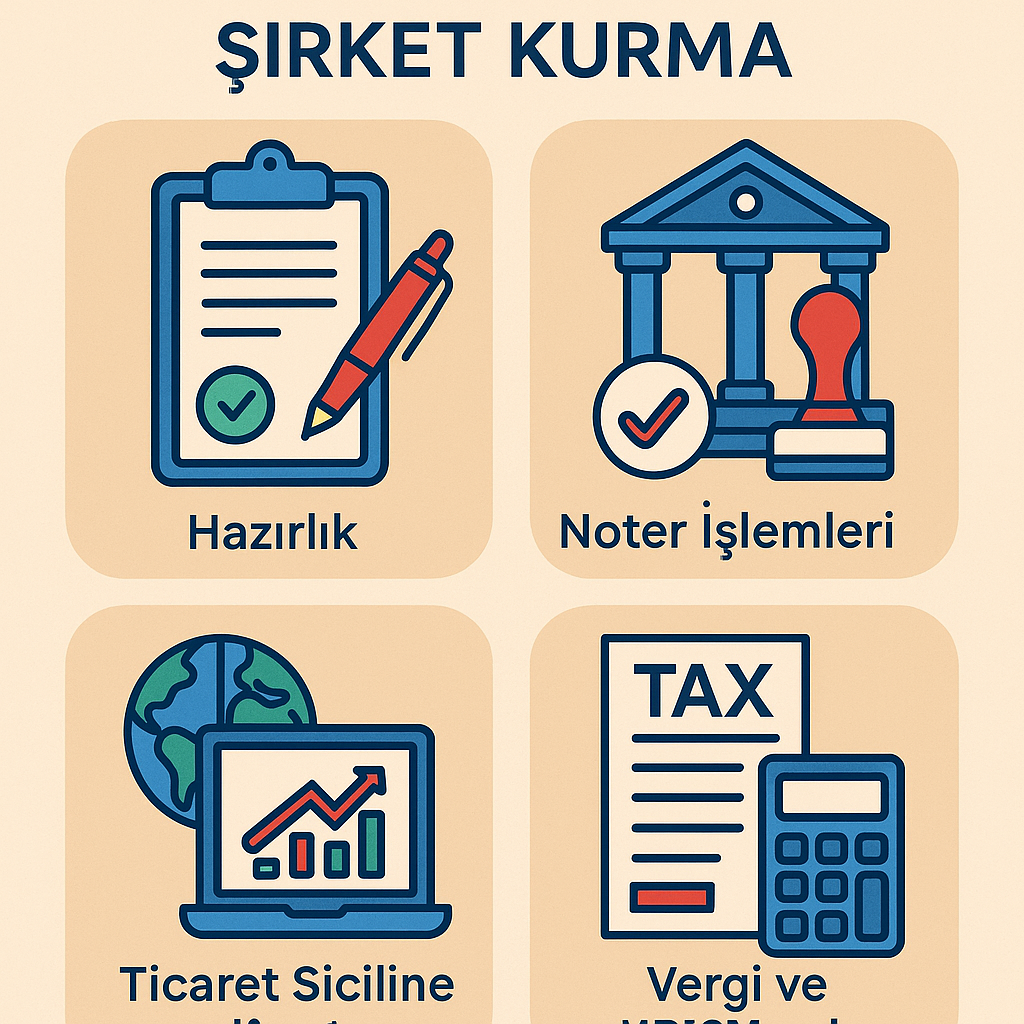
Establishment Process
1. Preparation
-
Determining the company name
-
Preparation of the main contract
2. Notary Procedures
-
The incorporation documents are signed in the presence of a notary public.
-
The capital is deposited into a bank account and blocked.
3. Registration in the Commercial Registry
-
Registration is done with the Italian Chamber of Commerce (Registro delle Imprese).
-
The company acquires official legal personality.
4. Tax and VAT Registration
-
Tax identification number (Codice Fiscale)
-
A VAT identification number (Partita IVA) is obtained.
Required Documents
-
Passports and identity documents
-
Sworn translation + apostille certification for documents to be obtained from Turkey.
-
Company address declaration
-
Draft Articles of Association
Tax and Accounting Obligations
-
Corporate Income Tax (IRES): 24%
-
Regional Tax (IRAP): 3.9%
-
VAT: 22% (4% and 10% in some sectors)
-
There is a requirement to submit annual financial statements and balance sheets.
Advantages of Establishing an SRL
-
Limited Liability: The personal assets of the partners are protected.
-
Access to the EU Market: Opportunities for free trade within the European Union.
-
Residence Permit Opportunity: Investors and managers who establish companies can obtain residence permits.
-
Flexible Management: Management with a single director is possible.
-
Low Start-up Cost: It can be established with lower capital compared to a SPA.
-
-
-
Legal and Practical Considerations
-
Bureaucracy in Italy can be slow, so it's recommended to have the processes handled through a lawyer.
-
Failure to properly manage tax liabilities through accounting can result in serious penalties.
-
Foreign investors must document the source of their funds in accordance with MASAK and EU AML regulations.
Establishing a limited liability company (SRL) in Italy is a safe, low-cost option for Turkish investors, offering access to the European market . With proper legal advice and financial planning, the company formation process can be completed within a few weeks. The SRL model stands out as the most suitable company type for both small businesses and growth-oriented enterprises.
Società per Azioni (SPA) – Joint Stock Company
For large-scale investors wishing to operate in Italy, the SPA (Società per Azioni), or joint-stock company model, stands out as the strongest corporate structure due to its capital size and the possibility of an initial public offering. The SPA model is largely similar to the joint-stock company structure in Turkey.
Capital Requirement
-
Minimum capital: 50.000 €
-
At least 25% of this amount must be deposited into the bank account during the establishment phase (the remainder can be added later).
-
If a single-shareholder SPA is to be established, the entire capital must be invested upfront.
4. Establishment Process
1. Preparation of the Articles of Association
-
The company's trade name, field of activity, capital structure, and governing bodies are determined.
2. Notary Approval
-
The articles of association are signed in the presence of a notary public.
-
The notary sends the documents to the Commercial Register (Registro delle Imprese)
3. Registration in the Commercial Registry
-
The registration process is completed for the company to officially acquire legal personality.
4. Tax Number and VAT Registration
-
The Codice Fiscale (tax number) and Partita IVA (VAT number) are obtained.
5. Opening a Bank Account
-
A bank account is opened in the company's name and capital is deposited.
Administrative Structure
SPAs have a more comprehensive corporate structure than SRLs. Their governing bodies are as follows:
-
General Assembly (Assemblea dei Soci)
-
Board of Directors (Consiglio di Amministrazione)
-
Supervisory Board (Collegio Sindacale) – mandatory in large-scale companies.
Tax Obligations
-
Corporate Income Tax (IRES): 24%
-
Regional Tax (IRAP): 3.9%
-
VAT: 22% (reduced rates apply to some products and services).
-
Publicly traded companies have additional reporting and audit obligations.
Advantages of Establishing a Spa
-
Suitable for Large Investments: High capital structure provides strong financial resources.
-
Initial Public Offering (IPO) Opportunity: The right to be traded on the stock exchange can attract international investment.
-
Investor Protection: Partners' liability is limited to the amount of capital they have invested.
-
Access to the European Market: Free trade and investment opportunities within the EU.
-
Corporate Image: Provides credibility in large-scale companies.
Things to Note!!
-
Establishing a SPA more costly and bureaucratic process compared to establishing an SRL (Small and Medium-sized Enterprise).
-
Investors must provide documentation proving compliance with AML (anti-money laundering) regulations in the EU and Italy
-
Additional regulatory requirements apply to initial public offerings and large-scale trading
Branch
Foreign investors wishing to operate in Italy can open a branch . This method stands out due to its low cost and quick establishment process.
What is a branch?
-
a separate legal entity ; it is an extension of the foreign company to which it belongs.
-
The parent company is responsible for all its obligations .
-
It may have its own balance sheet, but there is no obligation to contribute independent capital.
-
You can conduct business, sign contracts, and employ personnel in Italy.
Branch Opening Process
1. Decision and Authorization
-
The parent company's board of directors or general assembly decides on opening a branch in Italy.
-
This decision will be approved in writing.
2. Appointment
-
A legal representative is appointed for the branch in Italy .
-
This person is responsible for the branch's daily operations.
3. Notary Approval
-
The parent company's documents (commercial register, articles of association, etc.) are translated into Italian and apostilled.
-
The branch establishment document is signed in the presence of a notary public.
4. Registration in the Commercial Registry
-
The branch is registered with the relevant Chamber of Commerce (Registro delle Imprese) in Italy.
5. Tax Number and VAT Registration
-
A Codice Fiscale (tax number) and Partita IVA (VAT number) are obtained in the name of the branch .
4. Required Documents
-
The parent company's trade registry record
-
Articles of Association
-
Branch opening decision minutes
-
Passport and identification information of the appointed legal representative
-
Sworn translation and apostille certification required for documents obtained from Turkey.
5. Tax Obligations
-
The branch is taxed on the income it earns in Italy.
-
Taxes:
-
Corporate Income Tax (IRES): 24%
-
Regional Tax (IRAP): 3.9%
-
VAT: 22% (4% or 10% depending on the sector)
-
Advantages of Opening a Branch
-
Fast Setup: Completed in a shorter time compared to setting up a new company.
-
Low Cost: No minimum capital requirement.
-
Flexibility: It allows the parent company to conduct all its operations directly in Italy.
-
Residence Permit Opportunity: Work and residence permits can be obtained for branch representatives and employees.
Disadvantages
-
Unlimited Liability: The parent company is responsible for all debts and liabilities of the branch.
-
Corporate Image: It may not establish as strong a corporate structure as an SRL or SPA in the eyes of local investors.
-
Tax Liabilities: In Italy, there are separate tax liabilities for all income earned.
Partnerships
-
It is suitable for smaller-scale ventures, but it involves personal responsibility.
Types of Partnerships in Italy
🔹 Società Semplice (SS) – Simple Partnership
-
Suitable for small-scale activities.
-
Partners unlimited liability .
-
It is preferred not for commercial purposes, but rather for family businesses and property management
🔹 Società in Nome Collettivo (SNC) – General Partnership
-
All partners are liable for all company debts without limit.
-
Decisions are made among the partners.
-
It is generally suitable for small businesses.
🔹 Società in Accomandita Semplice (SAS) – Limited Partnership
-
There are two types of partners:
-
Limited partner: Unlimited liability.
-
Limited partner: Contributes capital, has limited liability.
-
-
This structure allows investors to keep risk to a minimum.
3. Establishment Process
-
The articles of association are prepared and signed in the presence of a notary.
-
Registration is completed with the relevant Chamber of Commerce ( Registro delle Imprese )
-
A tax identification number (Codice Fiscale) and a VAT identification number (Partita IVA) are obtained.
-
The partnership agreement clearly specifies the rights, duties, and responsibilities of the partners.
4. Tax Obligations
-
Profits earned from partnership companies are directly subject to the personal income tax of the partners.
-
The tax rate varies from partner to partner (income tax brackets 23% – 43%).
-
A regional tax ( IRAP ) is also applied
Advantages of Establishing a Partnership
-
Low Setup Cost: Easier and cheaper to set up compared to SRL or SPA.
-
Flexible Management: The decision-making process among partners is faster.
-
Ideal for Local Businesses: Suitable for small businesses, restaurants, and family businesses.
-
Simplified Taxation: Profits are distributed directly to the partners and are subject to their income tax.
Disadvantages
-
Unlimited Liability: Partners are liable with their personal assets (especially in SNCs and limited partnerships).
-
Lack of Corporate Image: It is not a reassuring structure for large-scale investors.
-
Difficulty Obtaining Credit: Banks generally offer fewer credit options to SRL and SPA companies compared to SRL and SPA companies.
In Italy, partnership structures offer a flexible and low-cost incorporation option , especially for small businesses, family companies, and entrepreneurs. However, since SNCs and limited partnerships carry the risk of unlimited liability for partners , these company types are generally preferred for local commercial activities rather than large-scale investments. While partnerships may be advantageous for Turkish investors seeking quick entry into the Italian market, stronger company types such as SRLs or SPAs should be preferred for long-term, high-capital investments. Therefore, it is essential to seek legal and financial advice to determine the most appropriate company type for your investment purpose .


About Post Author
